Roofing & exteriors in Hackensack, NJ
Hackensack is the county seat and Bergen's most populous city, and its housing is more mixed than any town around it. Early-1900s frame colonials, foursquares and two-families on small west-side lots, post-war capes and brick two-families, a mile of high-rises on Prospect Avenue, apartments over Main Street. Low ground by the river and a combined sewer make roofs, gutters and drainage the work that matters most here.
The city sits on the west bank of the Hackensack River at an average elevation of about 20 feet. The Pascack Valley Line splits it north to south: single-family streets mostly west of the tracks, the Prospect Avenue high-rise ridge and the Main Street corridor parallel to the river. About 46,000 people live in 4.35 square miles and roughly 20,000 housing units, so the stock leans toward apartments and two- and multi-family houses rather than detached homes.
Hackensack has been the county seat since 1710, and Washington camped on The Green in 1776, but the houses we work on are younger. Population went from 9,443 in 1900 to 24,568 in 1930, so most of the west-side stock dates from the streetcar and railroad years, with capes, splits and brick two-families filling in after the war. A century on, the frame houses show it: shingle at the end of its second layer, claddings stacked over the original wood, sash painted shut, five-inch gutters never sized for the roof. The flat-roofed two-families and downtown mid-rises fail at membrane seams, parapet caps and clogged drains.
We work on both: shingle and low-slope membrane roofing, siding over pre-war frame walls, window and door replacement, gutters and downspouts planned for a small lot on low ground, and decks.
Roofing on low ground, in the county's busiest city
Areas considered suburban single-family residential neighborhoods account for about one-third of the city's area, mostly along its western side.
Wikipedia, Hackensack, New JerseyTwenty feet above sea level. The water table is close everywhere, and the streets west of the railroad between Central Avenue and Passaic Street sit on a combined sewer that backs up into basements in heavy rain. The city announced a $9.2 million sewer-separation project there in May 2026. A downspout that dumps at the foundation is the one part of that problem a homeowner controls. We extend downspouts away from the wall and run them to daylight or a drywell where the lot allows.
Neighbors close enough to share a gutter. Lots are small on the west side and smaller downtown. A downspout cannot discharge onto the house next door, debris moves from the street, and a two-family's roof edge is often inches from the neighbor's. We plan access and drainage before we price the job.
Two roof geometries on one block. A pitched frame colonial stands beside a flat-roofed brick two-family. The colonial fails at eaves, valleys and chimney flashing; the two-family at membrane seams, parapet cap and drain. A leak in each starts in a different place.
Buildings that have been layered. A pre-war frame house is more often layered than stripped back to the wood: shingle over shingle, aluminum over asbestos-cement over clapboard, a replacement window inside the old frame. We open a corner and read the layers before we write a scope.
What Hackensack's housing stock actually needs
Architectural shingle on the west-side frames
Full tear-off on the 1900s to 1930s colonials, foursquares and capes, plank decking repaired, ice-and-water membrane at eaves and valleys. The shingle carries a published wind rating and goes on to qualify for the manufacturer's enhanced warranty. See how long a roof lasts in New Jersey.
Low-slope membrane on two-families and downtown
Single-ply membrane on the brick two-families and the mid-rises off Main Street, with drains, scuppers, parapet caps and party-wall flashing detailed as part of the roof. On low ground the drainage matters more than the membrane.
Gutters sized for the roof, routed for the lot
Six-inch gutters where a five-inch run overflows, oversized outlets, and downspouts extended away from the foundation and off the neighbor's lot. In the Anderson Street drainage area, keeping roof water out of the basement is the first job.
Older, tighter towns where the layers come off first.
The towns along the Hackensack River and Route 4 were built out earlier and denser than the northern valley. Pre-war frames and two-families stand on small lots, post-war capes and splits between them, on low ground near the water. The work is reading what earlier decades put on a house, fixing what is beneath it, and getting roof water off a small lot cleanly.
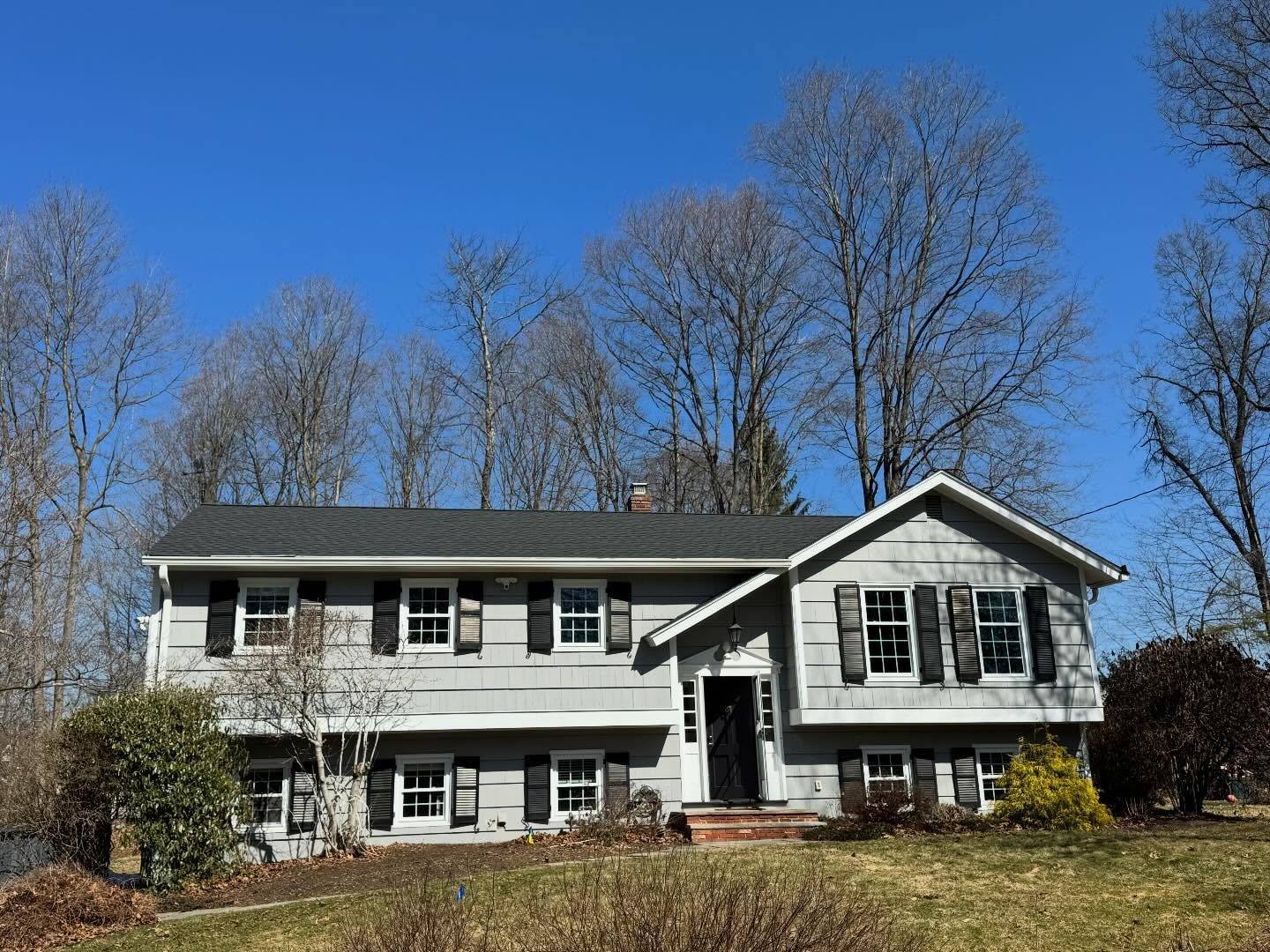
Neighborhoods and streets we work in Hackensack
ZIP code served: 07601.
- Fairmount — one of the three surviving neighborhoods of old New Barbadoes; early-1900s frame houses on small west-side lots
- Red Hill and Cherry Hill — the other two historic neighborhoods, pre-war frames with post-war infill
- Clay Street, Railroad Avenue, Berdan Place, James Street and Berry Street — the combined-sewer drainage area west of the railroad, where downspout routing matters most
- Prospect Avenue, Beech Street to Passaic Street — the mile-long high-rise district around Hackensack University Medical Center; flat roofs and terraces
- Main Street to State Street — downtown, apartments over storefronts and the new mid-rise buildings
- Around The Green, the Bergen County Courthouse and the Anderson Street and Essex Street stations — the city's oldest streets, two-families and apartments near the river
Hackensack response, anywhere in 07601. Call (201) 446-5941 or request a free written estimate online.
Adjacent Bergen towns
Does Johannemann & Sons serve Hackensack, NJ?
Yes — all of 07601, from the single-family streets of Fairmount and the west side to the two-families and flat-roofed buildings near Main Street and the river. We work across the county from our Edgewater base. In Hackensack that means shingle and membrane roofing, leak repair, siding over older frame walls, window and door replacement, and gutters routed so they drain away from a small lot.
My basement takes water in heavy rain. Could the roof or gutters be part of it?
Often, yes. Hackensack averages only about 20 feet above sea level, so the water table is close. The neighborhoods west of the railroad between Central Avenue and Passaic Street also sit on a combined sewer that the city is now separating. A downspout that empties at the foundation adds every gallon off the roof to that problem. We check where each downspout discharges, extend or re-route it, and size the gutters to the roof area before we look at anything else.
Can a new roof go over the old shingles on a hundred-year-old frame house?
Code allows a second layer of asphalt shingle, never a third, so a house that already carries two has to come down to the deck. On a 1900s to 1930s frame house we recommend a full tear-off regardless. It is the only way to see the plank decking, replace soft boards and install ice-and-water membrane at the eaves and valleys. It is also the only way the new shingles lie flat and hold their wind rating. The written estimate says which the house needs and why.
Roofing for the homes of Hackensack, NJ.
A free written estimate with photographs, named materials and a fixed scope, from a Bergen County exterior crew based in Edgewater.