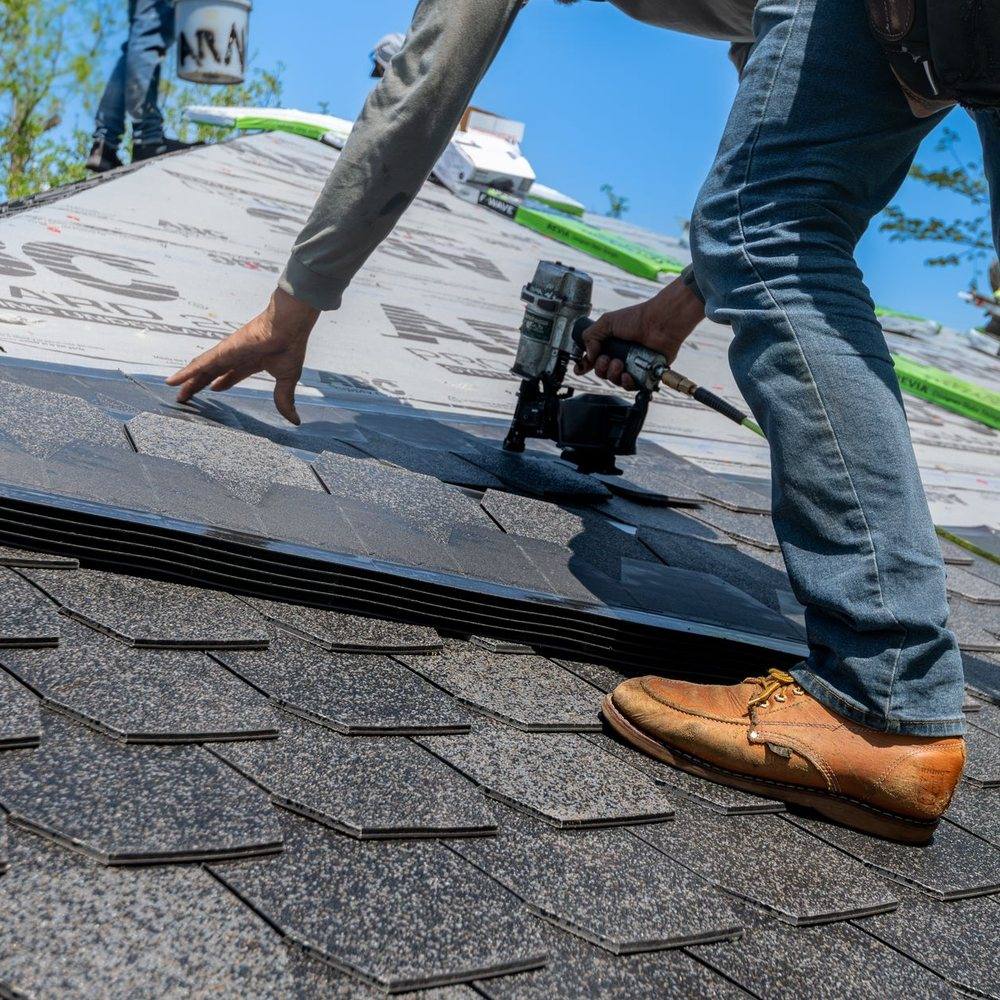
The stain is never under the hole.
Leak diagnosis and repair across Bergen County, in matched material — slate, cedar, standing seam or shingle. Water runs along a rafter before it drops, which is why roofs get patched three times in the same wrong place. We find the entry point, photograph it, and fix that. 24-hour assessment on an active leak, year-round.
Eight details leak. The field of the roof almost never does.
A roof surface is very good at shedding water. What fails is every place the surface is interrupted — and on a Bergen County house there are only so many of those. Working through them in order is what an assessment is.
Step flashing at a chimney or wall
The most common of all. Each course should have its own piece of metal woven in. Where there is roof cement instead, it has cracked, and cement over a crack is a repair of a repair.
Valleys
Where two slopes meet, the whole roof's water goes through a metal trough a few inches wide. Grit wears it, debris dams it, and a failed valley leaks a long way from where it shows.
Vent boots and pipe collars
The rubber collar around a plumbing vent has a service life of about fifteen years in full sun and the roof does not. Cheap, quick, and responsible for an enormous share of ceiling stains.
Skylight curbs
Rarely the glass. Almost always the flashing kit around it, or a skylight set into the deck without a curb at all. More on why skylights leak and when to replace one.
Eaves and ice damming
Melt refreezes at the cold overhang, water backs up under the courses and comes in over the wall plate. That is an attic problem wearing a leak costume; see how ice dams form.
Ridge and hip lines
Lifted ridge cap after wind, or a ridge vent fastened through its own baffle. High up, so it runs a long way before it appears.
Nail pops and old fastenings
Fixings back out as the deck moves through a few winters, lift the course above and open a hole each. On slate, corroded nails let sound stone slide out entirely.
Dormer cheeks and sidewalls
Where a dormer meets the main slope there is step flashing on both sides and a kick-out at the bottom. The kick-out is the piece most often missing, and without it the water runs straight down inside the wall.
Inside before outside.
Water entering a roof does not fall straight down. It runs along the underside of the sheathing, tracks down a rafter, crosses to a joist and drops wherever it finds a gap in the ceiling. Three meters of horizontal travel is ordinary. The ceiling stain tells you where the water gave up, not where it got in.
So the attic comes first. Daylight through the deck, damp or darkened sheathing, rusted nail tips, staining on the rafter sides, insulation that is compacted and wet in one patch. Those point back up the slope to a specific detail, and that detail is what gets photographed and quoted.
Where there is no attic access — a cathedral ceiling, a closed soffit — it is water testing instead: the roof is wetted in sections, low to high, until it reproduces. It is slow and it is the honest way to do it.
What you get
Photographs of the entry point, a written scope naming the failed detail and the material going back, and a price. If the answer is that the roof is past repairing, that is what the report says, with the evidence for it — and you keep the photographs either way.
What the 24-hour window actually means.
It means someone gets on the roof and the building gets dried in within a day. It does not mean the permanent repair happens that afternoon, and anyone promising that in February is promising something the weather decides.
Eyes on it, the source identified, and the water stopped — temporary covering if the roof is open and it is still raining.
The interior protected so the damage stops growing. Wet insulation out, so the ceiling below it has a chance.
Photographs and measurements, dated, in a form an insurer will accept if you decide to claim.
Once the roof is dry and matched material is on site. Rushing this is how a permanent repair becomes a temporary one.
If water is coming in now, call — do not wait on email.
A slate roof patched in asphalt is a repair you pay for twice.
The cheapest possible roof repair is a tube of sealant and whatever is on the truck. It buys a season. It also makes the next repair harder, because the proper fix now involves removing someone else's cement from around the detail that was failing.
We repair in the material that is up there. Slate in matched stock on copper nails. Cedar in matching grade with stainless fixings. Standing seam re-formed rather than screwed and sealed. Asphalt in the same product where it is still made, and an honest word about color blending where it is not.
Flashing gets formed metal, not cement. That is the single biggest difference between a repair that lasts as long as the roof and one that lasts until the next hard winter.
The same applies street by street, whether it is roof repair in Edgewater, Ridgewood, Ho-Ho-Kus, Allendale, Upper Saddle River, Franklin Lakes, Wyckoff or Glen Rock.
What a roof repair costs here.
Most leak repairs run $400–$3,000, set by where the water is getting in and what the roof is made of. Every repair is quoted in writing after a free inspection.
| Repair | Typical range |
|---|---|
| Plumbing or vent boot | $150–$600 |
| Lifted or missing shingles, slipped slate | $400–$1,500 |
| Skylight re-flashing | $400–$1,500 |
| Skylight replacement, unit and flashing | $1,200–$3,500+ |
| Chimney re-flashing or re-pointing | $500–$2,500 |
| Valley rebuild | $800–$4,000+ |
| Slate repair: 5–20 slates and a valley | $1,500–$6,000 |
What homeowners ask about repairs
How quickly can you get to a roof leak?
We hold a 24-hour assessment window for active leaks, year-round. That means someone gets eyes on it and the building gets dried in within a day — not that the permanent repair happens that afternoon, because a proper repair often needs a dry roof and matched material. We will tell you which stage you are at when we are up there.
How do you find where a leak is coming from?
From the inside first, then the outside. Water runs along rafters and decking before it drops, so the ceiling stain is almost never under the hole. We look in the attic for the entry point — daylight, damp sheathing, rusted nail tips — and work back up the slope to the detail that let it in. Guessing from the stain is how roofs get patched three times in the same place.
Do you repair slate, cedar and metal, or only shingle?
All of them, in matched material. That is most of the point: a slate roof patched with asphalt, or a cedar roof patched with the wrong grade, is a repair you will pay for twice. We source matching stock and form metal on site rather than reaching for whatever is on the truck.
Will the repair match the rest of the roof?
On slate, cedar and metal, yes — we match stock and form flashing to suit. On asphalt, an honest answer: a twelve-year-old roof has weathered, and new shingles of the same product will not match exactly for the first year or two. They blend. If a perfect match matters more than the money, that is worth saying at the estimate.
Is it worth repairing an old roof at all?
Often, yes. A sound roof with a failed flashing is a repair no matter how old it is, and the age of a roof is a poor predictor on its own. What makes repair the wrong answer is the field of the roof failing — brittle shingles across several slopes, soft sheathing, or three repairs already paid for in a few years.
What does a roof repair cost in Bergen County?
Most leak repairs run $400-$3,000, depending on the source and the roofing material: a plumbing or vent boot is $150-$600, chimney re-flashing $500-$2,500 and a valley $800-$4,000+. Every repair is quoted in writing after a free inspection.
Next to this
Roof replacement
What a tear-off actually involves, what changes the price, and what a real scope contains.
Replacement →Where leaks start
The same seven details, worked through with what each one looks like from the attic.
Read →How long a roof lasts
Lifespan by material in this climate, and the signs that yours is near the end.
Read →Gutters
A surprising share of "roof leaks" are overflowing gutters putting water behind the fascia.
Gutters →Find the leak before you price the roof.
We get into the attic, get on the roof where it is safe to, and send photographs of the actual entry point with a written scope. Free, no obligation, and the photographs are yours whether or not you use us.