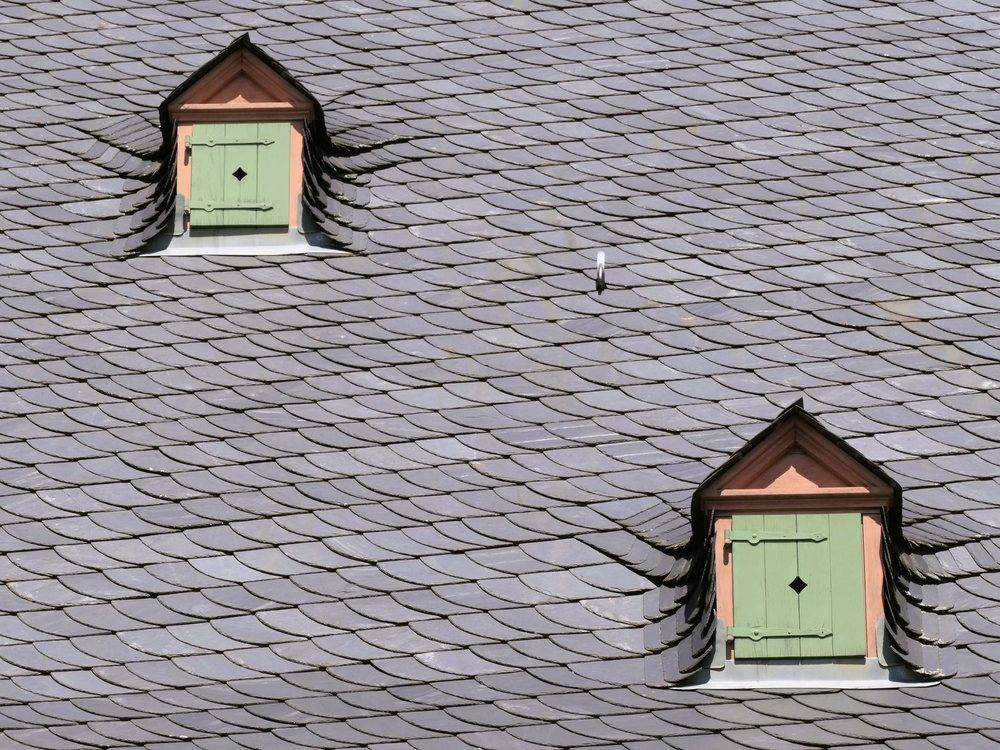
Slate roofs, repaired before they are replaced.
Restoration, selective replacement and complete re-slating across Bergen County — natural stone and synthetic, on copper flashing, in matched stock. Most of the slate roofs we are called to look at do not need to come off. We tell you which yours is, in writing, with photographs, before anyone quotes a tear-off.
A slate roof usually fails everywhere except the slate.
Bergen County still wears a great deal of its original slate — on the Tudors and center-hall colonials of Ridgewood, Ho-Ho-Kus and Upper Saddle River, on the estate houses in Alpine and Saddle River, on street after street of pre-war Tenafly and Englewood. Much of it was laid between the 1890s and the 1930s. Quite a lot of it has another fifty years in it.
What does not have another fifty years in it is everything holding the slate on. Nails corrode. Copper valleys wear through where a century of grit has run down them. Step flashing at a chimney gets patched with roof cement by someone in a hurry, and the cement cracks. The roof starts leaking, a contractor looks at a hundred-year-old roof and quotes a tear-off, and a material with decades of service left goes into a skip.
The two questions that decide it
Is the stone still sound? Good slate rings when you tap it and resists being handled. Slate at the end of its life is soft at the edges, delaminates in sheets and breaks when you lift it. That is a genuine end of life and no amount of flashing work fixes it.
Are the fixings still holding? Slates sliding out of an otherwise sound roof usually mean nail sickness — the fastenings have rusted away while the stone stayed perfect. A roof can be re-laid using its own slate when that happens, which is a different job and a different number from a replacement.
Those two answers are what an assessment is for, and they are why we photograph the roof rather than describe it. You keep the photographs whether or not you use us.
Natural or synthetic.
Both are real answers. Which one is right is decided by the structure first and the budget second — in that order, because one of them is not negotiable.
Natural slate
Quarried stone. What the house was built for, and the only material on this list measured in centuries.
- 75–150+ years, routinely outlasting the structure
- Class A fire rating
- Color and texture that no manufactured product reproduces up close
- Individually replaceable — a damaged slate is a repair, not a section
The constraint: roughly 800–1,500 lbs per square. The framing has to carry it, and on a house that never had slate, usually cannot without work.
Synthetic slate
Molded composite. The appearance and the fire rating at roughly the weight of a heavy architectural shingle.
- Manufacturer warranties up to 50 years
- Class A fire rating
- No structural reinforcement on a conventionally framed roof
- Consistent thickness, which makes for a faster and cheaper installation
The trade: it is a very good impression of stone rather than stone. Close up, and over sixty years rather than a hundred and twenty, the difference shows.
Slate punishes ordinary roofing habits.
Slate is not a material most roofing crews handle, and the ways it goes wrong are specific. It is hung, not nailed tight — a slate driven home cracks the moment the deck moves. The nails have to be copper or stainless, because a hundred-year stone on a twenty-year fastening is a twenty-year roof. Headlap has to be right for the pitch or water tracks sideways under the course above.
The flashing is where the money and the craft are. Valleys, chimneys, dormer cheeks and every penetration get formed metal — copper on the work that is meant to last, because it is the only flashing metal with a service life in the same range as the slate. A tube of roof cement at a chimney is the single most common thing we find on a leaking slate roof, and it is always a repair of a repair.
Done properly, a slate roof is the last one the house needs for a very long time. Done in a hurry, it leaks regardless of how good the stone was.
Restoration or replacement on a Bergen Tudor walks through the same decision in more detail, with the three things we look for in the attic.
Four kinds of slate job.
A slipped or broken slate, a failed valley, a chimney that has been cemented instead of flashed. Matched stock, formed metal, and the rest of the roof left alone.
Whole elevations re-laid, valleys and step flashing renewed in copper, sound slate kept. The usual answer on a pre-war roof that is leaking in three places.
Where the fixings have gone but the slate has not. The roof comes off, the deck and underlayment are renewed, and the original stone goes back up on copper nails.
New natural or synthetic slate over a renewed deck, underlayment and flashing. Specified to the structure, with the weight calculation done first.
What slate work costs.
Most slate roofs need restoring before they need replacing, and the difference in price is large. Replacement figures are for the whole roof, because on a Tudor the detail work moves the price as much as the area.
| Work | Typical range |
|---|---|
| Targeted repair: 5–20 slates, a valley, a chimney re-point | $1,500–$6,000 |
| Broader restoration (adds 15–25 years) | $6,000–$20,000+ |
| New roof, 2,500 sq ft Tudor, Pennsylvania slate | $40,000–$70,000 |
| New roof, 2,500 sq ft Tudor, Vermont slate | $60,000–$100,000 |
| New roof, 2,500 sq ft Tudor, synthetic slate | $50,000–$75,000 |
| New roof, typical Tudor, 3,500–4,500 sq ft | $60,000–$120,000 |
What homeowners ask about slate
How long does a slate roof last?
Natural slate commonly lasts 75 to 150 years, often outliving the building it is on. Quality synthetic slate carries manufacturer warranties up to 50 years. In practice what fails first on a hundred-year-old slate roof is almost never the slate — it is the flashing, the valleys and the nails holding the slate up.
Is my house strong enough for natural slate?
Natural slate weighs roughly 800 to 1,500 lbs per hundred square feet, several times an asphalt roof, so the structure gets assessed before anything is specified. A house that already carries slate can carry slate again. If a house was never built for it and reinforcing the framing is not practical, synthetic slate gives the appearance and the fire rating at roughly the weight of a heavy shingle.
What is the difference between natural and synthetic slate?
Natural slate is quarried stone: unmatched depth, color variation and lifespan, heavier and more costly. Synthetic slate is a molded composite — lighter, cheaper to install, dimensionally consistent, and good enough at three meters that most people cannot tell. The honest split is authenticity and lifespan against weight and budget.
Can you repair an existing slate roof rather than replace it?
Usually, and it is most of the slate work we do. Individual slates slip, crack or delaminate long before the roof as a whole is finished. We source matching stock, replace the damaged pieces, renew the copper flashing and leave a roof that may have decades left. A slate roof is generally replaced because its flashing and fastenings are gone, not because the stone is.
How do I know whether my slate is at the end of its life?
Two tests. Slates that break or crumble when handled — rather than ringing when tapped — mean the stone itself is spent. Nail sickness, where sound slates are slipping because the fixings have corroded, means the roof is coming off whatever the slate looks like. We photograph both and put it in writing before anyone quotes a tear-off.
What does slate roof repair or replacement cost?
A targeted slate repair typically runs $1,500-$6,000 and a broader restoration $6,000-$20,000+. A new roof on a modest 2,500 square foot Tudor runs $40K-$70K in Pennsylvania slate, $60K-$100K in Vermont slate and $50K-$75K in synthetic slate; a typical 3,500-4,500 square foot Tudor runs $60K-$120K.
Next to this
Roofing
The whole roofing page: repair versus replacement, the seven layers, and how a re-roof runs.
All roofing →Cedar shake
The other pre-war roof on these streets, and the one that most depends on what is underneath it.
Cedar →Standing seam metal
Copper, zinc and aluminum on concealed clips — the long-life roof without the weight.
Metal →Copper gutters
What usually goes up at the same time as a slate roof, and for the same reason.
Gutters →Find out whether it actually needs replacing.
We get on the roof where it is safe to, photograph what is there, and send a written scope that says which of the four jobs above yours is. No obligation, and the photographs are yours either way.