Roofing & exteriors in Wyckoff, NJ
Wyckoff is high ground west of the Saddle River, a township that was still a third farmland in 1940 and quadrupled in the decades after the war. That leaves mostly post-war colonials, split-levels and ranches on generous lots, a scattering of Dutch-era farmhouses, and a mature tree canopy over almost every roof, gutter and north-facing wall.
Roof leak, overflowing gutters, tired siding or windows? We assess roofing and exterior problems across Wyckoff, photograph what we find and give you a free written estimate before you decide.
The name is traced to a Lenape word for high ground; the township sits at roughly 331 feet on the rise toward the Ramapo foothills, with Deep Voll Brook running through it. Dutch families were farming here by about 1720; the Terhune House on Godwin Avenue dates from 1737. The railroad arrived in 1870 and changed little: in 1940 the population was just under 4,000, with 30 percent of the land still farmed. The township itself was formed in 1926, out of Franklin Township, and marks its centennial this year.
The jump from about 4,000 residents to today's 16,585 came in the post-war decades, with passenger rail ending in 1966 as the town turned to the car. So the streets are mostly 1950s-to-1970s colonials, split-levels and ranches on large lots, with post-1990 custom rebuilds and the old stone-and-frame farmhouses scattered between. Nine in ten homes are owner-occupied at a median value above $800,000: houses held for decades and maintained. It is a Tree City USA community, which on a roof means shade, leaf load and limbs.
What fails first is consistent: moss on a shaded north slope, ice at the eaves in February, 5-inch gutters full of maple leaves, a near-flat garage roof wearing shingles, and aluminum siding hiding a soft sill. We handle roof replacement and leak repair, siding, windows and doors, gutters and decks across the township, with the scope in writing first.
What we check first on a Wyckoff house
What the trees are doing to the roof
We walk the lot before the roof. Which slopes never see sun, which limbs overhang and what falls into the gutters each fall decide the shingle we specify and whether guards make sense. Moss on a shaded slope is a drying problem, and it shortens a roof's life.
The ice-dam record at the eaves
Stained soffits and lifted starter courses tell us where ice has been sitting. Then we go into the attic: insulation depth, soffit vents painted shut or stuffed with batts, exhaust fans blowing into the rafters. The barrier on the new roof is sized to that history.
The low-slope wing on the split-level
Many of Wyckoff's splits carry a shallow roof over the garage or the one-story block, meeting a wall of the taller section. We measure the pitch, look for a membrane rather than shingles, and check the flashing where the low roof dies into the siding; that joint is where the ceiling stain comes from.
Where the water goes on a big lot
A large roof drains a lot of water, and a downspout that stops at the foundation sends it into the basement. We trace every outlet, plan extensions or drains to daylight, and on the low ground along Deep Voll Brook we look at grading before we talk about gutters.
What Wyckoff's houses call for
Roofing for shaded slopes
Algae-resistant architectural shingle over synthetic underlayment for the post-war colonials and splits, stripped to the deck, with ice-and-water barrier run deep at eaves and valleys. Cedar shake or standing seam metal where a custom rebuild earns it. See how long a roof lasts in New Jersey.
Gutters sized to the trees
Six-inch seamless aluminum with oversize outlets, downspouts run clear of the foundation, and guards chosen for maple and oak litter. Guards under a Bergen canopy explains which ones survive it.
Siding over the original walls
On post-war houses, vinyl and aluminum often went on over the first cladding. We open a corner at a window to see the substrate, replace rotted sills and flash every head before new fiber-cement or vinyl goes up. On the Dutch-era houses we work around original fabric.
Windows & doors
Original 1950s-to-1970s units are usually past weatherstripping; those get replacements sized to the existing opening. Where a farmhouse still has its wood sash, repair comes first. See window replacement costs in Bergen County.
Big lots, heavy trees and winter on every eave.
North-west Bergen runs from the village streets around Ridgewood out to the Ramapo foothills; the further out you go, the larger the lots and the older the trees. Roofs are shaded, gutters fill twice a year and ice forms on north eaves every winter. It asks for a contractor who sizes drainage to the roof and the trees above it.
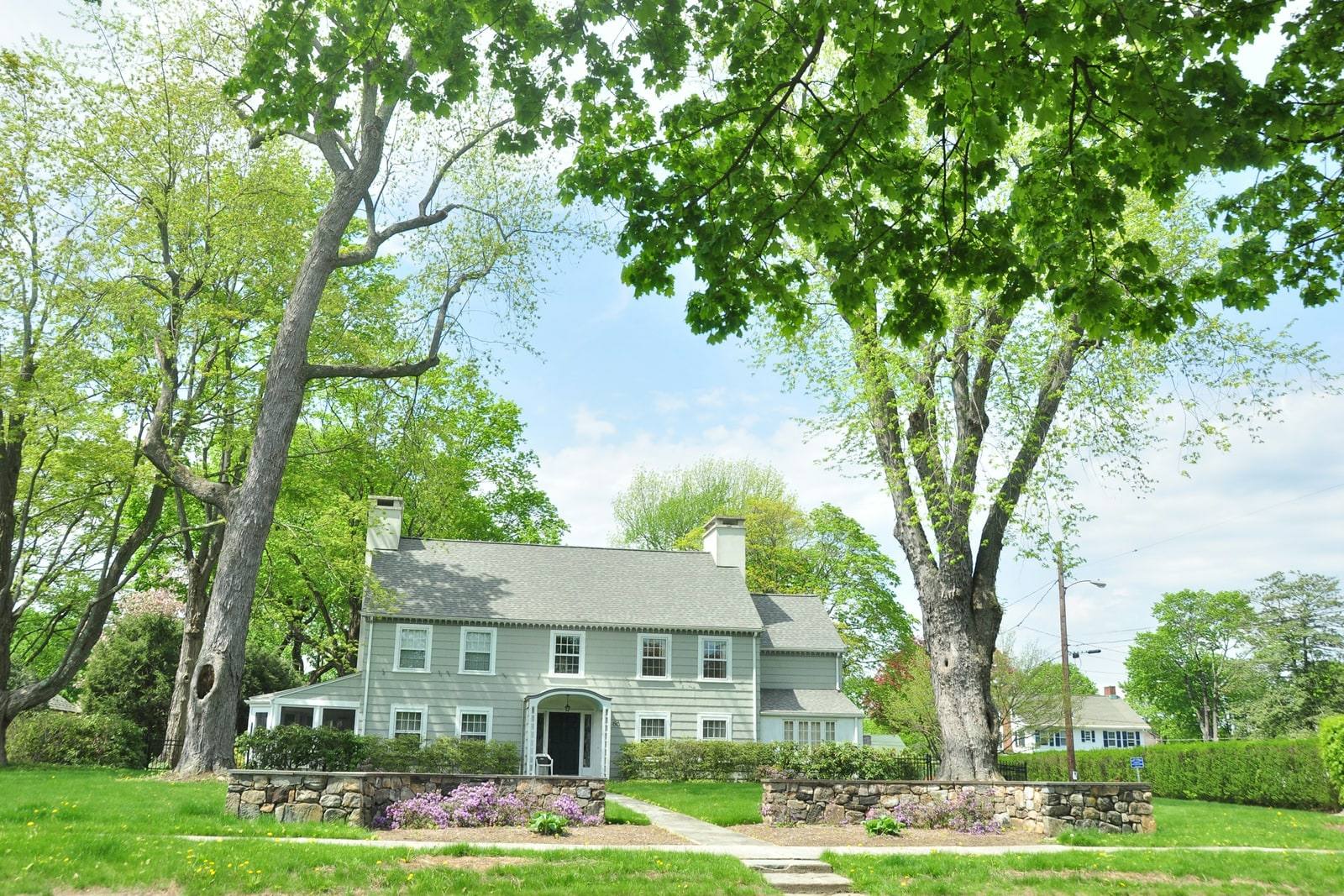
Neighborhoods and streets we work in Wyckoff
ZIP code served: 07481.
- Sicomac: the township's named section, around Sicomac Elementary School, post-war single-family streets under heavy canopy
- Godwin Avenue: the historic road through the township, home to the Terhune House of 1737 and the Dutch-era houses that call for slower work
- Franklin Avenue: the main street, with Memorial Town Hall at Scott Plaza, and the residential blocks off it on both sides
- Goffle Road: the road out toward Hawthorne and the Passaic County line, past Bergen County's last live poultry market, with post-war houses along and off it
- Deep Voll Brook: the low ground along the brook, where downspout discharge and grading matter as much as the roof
Wyckoff response, anywhere in 07481. Call (201) 446-5941 or request a free written estimate online.
Adjacent Bergen towns
Does Johannemann & Sons serve Wyckoff, NJ?
Yes — all of Wyckoff, ZIP 07481, from the Sicomac section to the streets off Godwin Avenue, Franklin Avenue and Goffle Road, and the low ground along Deep Voll Brook. The township is 6.65 square miles of mostly post-war single-family houses on large, heavily treed lots. So the work is shingle roofs under mature trees, gutters that fill twice a year, and siding and windows from the 1950s through the 1970s. We reach Wyckoff from our Edgewater base, and the estimate is written, with photographs.
Why does my Wyckoff roof get ice dams every winter when my neighbor's does not?
Almost always because of what is under it, not on it. Wyckoff's canopy keeps north-facing slopes cold and shaded, so any heat leaking from the house melts snow higher up and refreezes at the cold eave. The source is usually thin attic insulation, blocked soffit vents or an exhaust fan dumping warm air under the deck. On a re-roof we run ice-and-water barrier well past the warm wall line, open the soffits and add ridge venting, and the estimate says whether the attic itself needs attention.
My split-level has a nearly flat roof over the garage. Can it take shingles like the rest of the house?
Not below a pitch of about 2-in-12, and many garage and one-story wings on Wyckoff's 1960s splits are close to that. Asphalt shingle relies on gravity; on a shallow slope water sits, backs up under the laps and finds the nails. Those sections get a fully adhered membrane instead, lapped up the wall of the two-story block behind metal counterflashing, with a kick-out where it meets the siding. The steep slopes above still take architectural shingle, and the joint between the two systems is where we spend the most time.
Roofing for the homes of Wyckoff, NJ.
A free written estimate with photographs and the materials named by brand, from a Bergen County exterior crew based in Edgewater.