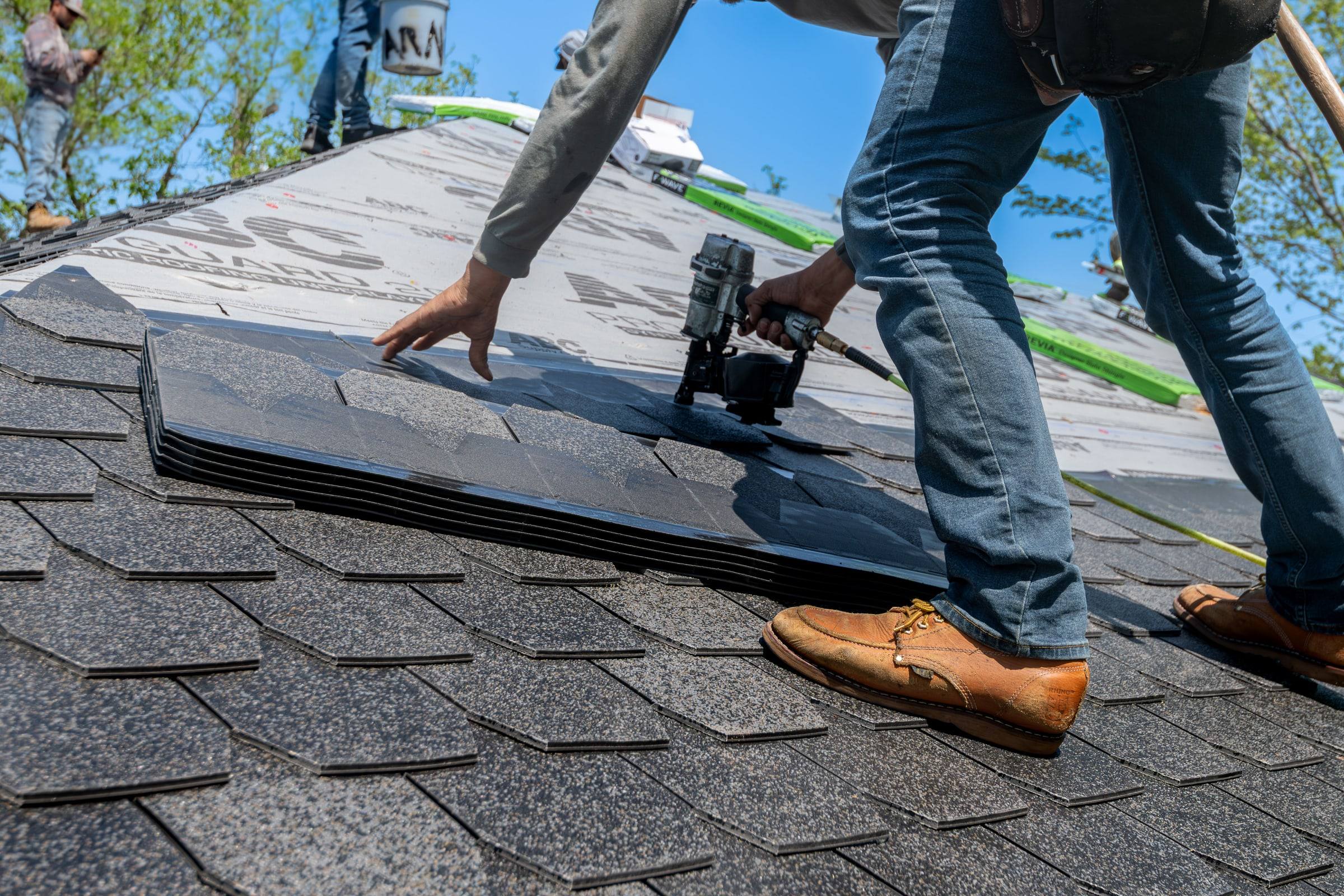
The shingle is the cheapest part of a shingle roof.
Most Bergen County roofs are asphalt, and almost none of them fail because the shingle was wrong. They fail at the eaves, at the flashings, and from underneath, in a roof space nobody vented. That is where the money should go, and it is where ours does.
Architectural, not three-tab.
This is the one shingle decision worth having an opinion about, and on a Bergen County house it only goes one way.
Architectural — what we fit
- Two bonded layers, so the butt reads thick and the roof has shadow in it
- Higher tested wind rating, which is what matters on an exposed slope
- Handles a cut valley, a hip and a complex roof without looking cheap
- Longer manufacturer rating, and the only one worth registering
- Looks right against brick, stone, stucco and painted clapboard
Three-tab — and why it is not on the quote
- One flat layer, no depth, and it shows on any roof with a gable you can see
- Shorter service life in every comparison
- Lower wind rating on the same house
- Cheaper on the day by a fraction of what the roof costs over its life
- The tell in a low quote — if a number looks too good, check which of the two it is for
Four things, and only one of them is the shingle.
Whether the roof can breathe
Intake at the soffits, exhaust at the ridge, and a clear path between them. Insulation stuffed into the eaves blocks the intake, and a ridge vent fastened through its own baffle blocks the exhaust. A roof that cannot breathe bakes from underneath and loses years, whatever it says on the wrapper.
How far the membrane runs at the eaves
New Jersey's code requires ice-and-water shield only in Sussex County, so in Bergen it is up to the roofer. We run it past the inside face of the wall as a minimum. On a north slope under trees, a shallow pitch or a deep overhang, that line is not far enough, and the difference between a dry ceiling and a claim is a roll of membrane.
Six nails, in the nail line, driven flush
Not four. Not overdriven so the head cuts through the mat, not proud so it lifts the course above. It is the least glamorous line on the scope and it is most of the wind rating.
Whether the flashings were renewed or re-used
New metal formed at every chimney, wall, valley, skylight and dormer cheek — or the old metal bedded back into sealant, which looks identical from the ground on handover day and fails in about three winters.
What is under the shingle, in the order it goes on.
- The deck. Inspected once the old roof is off, and photographed. Soft, delaminated or charred sheathing is replaced and charged per sheet against what was actually used, not against a flat allowance decided before anyone had seen it.
- Ice-and-water membrane. Eaves, valleys, rakes and every penetration, run past the inside face of the exterior wall and further where the slope, the shade or the pitch asks for it.
- Synthetic underlayment. Over the rest of the field. Lighter, tougher and far less slippery underfoot than felt, which matters to the people on your roof.
- Drip edge and starter. Metal at every eave and rake, starter course sealed, because this is the edge that wind gets under first.
- New flashing. Step flashing woven course by course at walls and dormer cheeks, a kick-out where the roof meets a wall above a gutter, and formed valley metal.
- The shingle. Six nails, staggered to the manufacturer's pattern, hips and ridges capped in matched material.
- Ventilation. Ridge vent that is actually open, intake cleared at the soffits, and every bath and kitchen fan terminating outside rather than into the roof space.
Franklin Lakes — full shingle replacement.
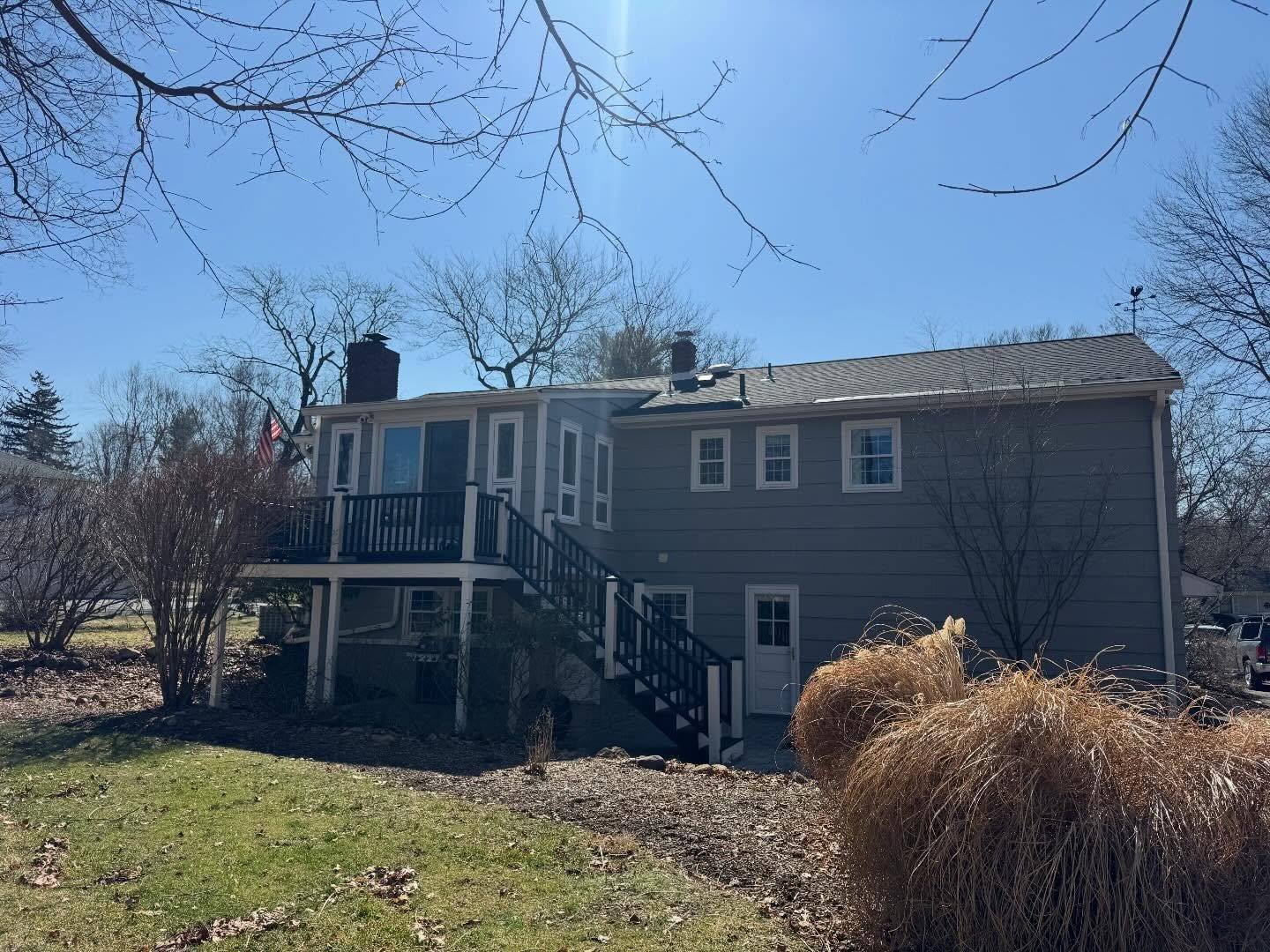
A complete tear-off and replacement in GAF Charcoal, with a section of deck rebuilt at the same time, carrying our lifetime workmanship warranty. It is one of the firm's own jobs and one of the firm's own photographs — the whole job is on the Franklin Lakes project page.
A charcoal architectural shingle is the safest choice on the majority of Bergen houses for a reason: it reads as a roof rather than as a color, and it sits under brick, stone, cedar and white trim without arguing with any of them.
When asphalt is the wrong roof for the house.
Not often — but often enough in this county to be worth a paragraph, because Bergen has housing stock that predates asphalt entirely.
- A slate roof that is still sound. Stripping serviceable stone to put asphalt on it throws away decades of remaining life and, on a pre-war house, a good deal of what the house is. See slate.
- A cedar roof on a house designed around it. Shingle-style and Tudor Revival houses carry cedar for a reason, and the substitution shows from the street. See cedar shake.
- A low-pitch roof, a porch or a bay. Below the pitch asphalt is rated for, the right answer is a standing seam or membrane section, not a shingle laid flatter than it is meant to go.
What a shingle roof costs.
Architectural shingle is the least expensive roof to install here. Decking, flashing and ventilation are priced as their own lines, so you can see them.
| Item | Typical range |
|---|---|
| Architectural shingle, roof only | $4–$7 per sq ft |
| Tearing off one layer | $2–$6 per sq ft |
| A 2,500 sq ft roof, with tear-off | about $15,000–$32,500 |
How long should an asphalt shingle roof last in New Jersey?
An architectural shingle carries a long manufacturer rating, and the roofs that reach it are the ones that were vented properly and nailed properly. In this climate the common failure is not the shingle wearing out — it is a roof that cooked from underneath because the soffits were blocked or the ridge vent was fastened through its own baffle, and gave up a decade early. Three-tab roofs are shorter-lived than architectural in every case.
What is the difference between architectural and three-tab shingles?
Three-tab is a single layer cut into tabs: flat, light, and the cheapest roof anyone will quote you. Architectural (also called dimensional or laminate) bonds a second layer on, which makes it heavier, thicker at the butt, better wind-rated and far better looking on a Bergen County house with any depth to its roof. We fit architectural as standard and would talk you out of three-tab on almost any house here.
How many nails should go in each shingle?
Six on anything exposed, not the four the minimum instruction allows. Nails go in the nail line, driven flush — not overdriven so the head cuts the mat, not underdriven so it sits proud and lifts the course above. It costs a little more labor and it is most of the difference between a roof that keeps its wind rating and one that does not.
Do I need ice-and-water membrane, and how far up?
Yes, at every eave, even though New Jersey's code requires it only in Sussex County. We run it at least two feet past the inside face of the exterior wall, the model code's line; on a low-pitch roof, a deep overhang or a north slope under trees, that line is not far enough and we run it further. Valleys, rakes and every penetration get it too. This is one of the five line items that explains most of the gap between two quotes on the same house.
Can you put new shingles over the old ones?
We do not. Going over saves the tear-off and the disposal on the day and costs more afterwards: you cannot inspect the deck you are covering, the new roof runs hotter and ages faster, and the flashings get re-used or bedded in sealant rather than renewed. Most manufacturers will not warrant a system laid over an existing roof either.
Does shingle color matter here?
Less than the internet suggests, and more than nothing. A dark roof runs hotter, which matters if the roof space is poorly vented and matters very little if it is vented properly. Choose for the house — what reads right against brick, stone, cedar or painted siding — and fix the ventilation separately rather than trying to solve it with color.
What warranty do I get?
Two separate things, and they get confused. The manufacturer warrants the material, and a system warranty has to be registered with them, with the installer's credentials, inside a window after completion — we file that and send you the confirmation. Separately, our own workmanship covers the installation. Ask any roofer which of the two they are quoting; unregistered paper in a folder is a brochure, not a warranty.
What does an asphalt shingle roof cost?
About $4-$7 per square foot for architectural shingle, plus $2-$6 per square foot to tear off the old roof, so roughly $15,000-$32,500 for a 2,500 square foot roof. Decking, flashing and ventilation are priced as their own lines after we measure.
Where to go next.
Roof replacement
The five lines that explain almost every price gap between two quotes.
Details →Roof inspection
How much life the roof you have actually has left in it.
Details →Slate
The material asphalt most often replaces, and when it should not.
Details →In the Journal
How long a roof lasts in New Jersey, by material.
Read →Get a scope that says what goes under it.
Membrane extent, flashing, deck allowance, ventilation and nailing, all as line items — so you can hold our quote against anyone else's and see what the difference actually is.