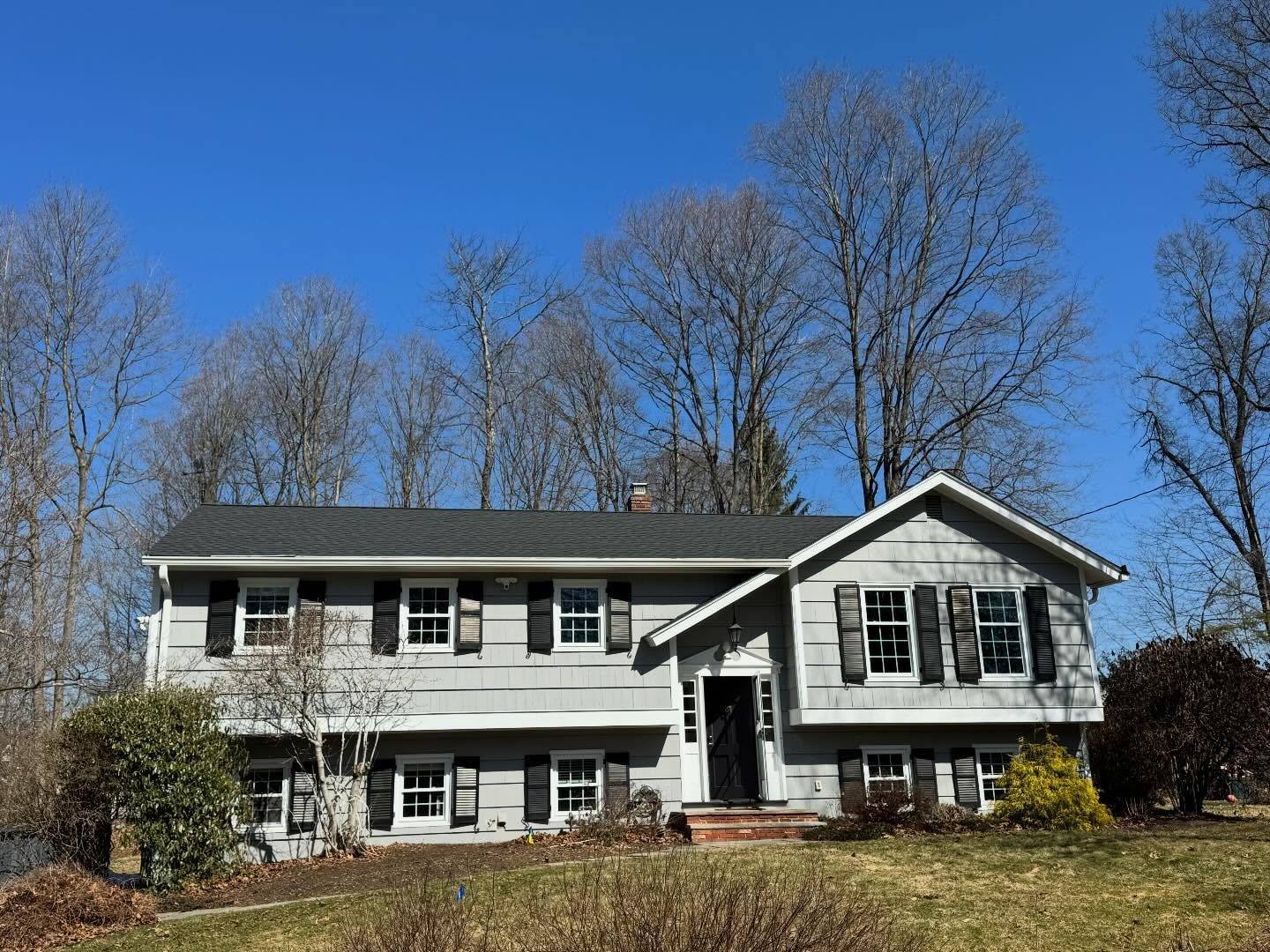
Bogota is eight-tenths of a square mile of flat ground on the east shore of the Hackensack River, a railroad borough that filled in between 1900 and 1920. That means small lots, houses a few feet apart, roofs from the same decades, and low blocks by the river where water has to be moved on purpose. We roof, side, re-window and re-gutter those houses.
In detail
Bogota was Bogert-family farmland until the railroad brought industry and houses in the late 1800s. It became a borough on November 14, 1894, one of 26 Bergen boroughs formed that year, and the census shows it: 337 residents in 1900, 1,125 in 1910, 3,906 in 1920. The residential grid west of the CSX River Line was laid out in those two decades. Today 8,778 people share three-quarters of a square mile of land, one of the denser towns in the county.
The River Line splits the borough. East of the freight tracks is largely industrial, with busy roads and low-slope commercial roofs. West of it is the suburban half: storefronts along West Main Street, River Road and West Fort Lee Road, and the small-lot houses behind them. On a house of that age the failures are predictable. Chimney and sidewall flashing gets buried under a second layer of shingle, and the back roof is often pitched too flat for shingle at all. Aluminum or vinyl was laid over the original wood with nothing behind it, and 5-inch gutters hang on a roof that needs 6-inch.
Then there is the river. The low-lying homes nearest the Hackensack flood in heavy rain. National flood-risk modeling records three major flooding events in the borough and puts 6.6 percent of its properties at risk over the next 30 years. That changes where the water has to go when it leaves the roof. If you have a leak now, start with roof repair; if the water is at the foundation, start with gutters.
What is different here
Roofing in Bogota: what the borough asks of us
Two decades built the town
Most of the grid went up between 1900 and 1920, so most roofs share a history: the original covering long gone, then rounds of asphalt. We count layers at the eave and rake, probe the deck, and price the tear-off before anyone signs.
Houses a few feet apart
At roughly 11,500 people per square mile, a downspout emptying into a shared side yard soaks two foundations. We route downspouts to the front or rear, run them to daylight or a working drain, and size gutters so they do not overshoot.
Low ground by the river
The blocks nearest the Hackensack carry the borough's flood record. Downspout routing, splash blocks, and siding and trim held clear of grade decide whether a wet week reaches the framing.
Freight and highway on the doorstep
The CSX River Line runs through the middle of town; Interstate 80 and Route 4 serve it. Light siding near the corridor picks up grit and windows facing the tracks carry noise; we specify claddings that hose clean and laminated glass where it earns its cost.
The main pitch takes a GAF or CertainTeed architectural shingle over ice-and-water membrane at eaves, valleys and walls. The flat back roof gets a fully adhered membrane instead of shingle laid too flat. Where the problem is a leak rather than the roof, we find the source before we quote.
Aluminum or vinyl over original wood with no weather barrier is common here. We open a test area, photograph what is under it, and re-clad in fiber cement or a quality vinyl over a proper weather-resistive barrier, flashed at every opening, with trim held above grade.
A replacement sash sized to the existing frame keeps the trim and the look of the street; a rotted frame gets a full-frame unit flashed into the siding. Costs are in our window pricing guide.
Seamless aluminum, 6-inch where the roof area calls for it, downspouts kept out of shared side yards and run to daylight. On the riverside blocks this is the work that matters most and costs least. Decks for the back yards round out the list.
Central Bergen
Flat streets, close houses, water sent somewhere on purpose.
Central Bergen is the county's river lowland: the Hackensack and Saddle drainages, flat streets, dense pre-war and post-war grids. The work here is less about slate and more about getting shingle, membrane and gutters right on houses that stand close together and low to the water table.
Yes — every street in 07603, on both sides of the CSX River Line, from our Edgewater base. Bogota is a small, flat borough on the east shore of the Hackensack River, built out mostly between 1900 and 1920, so the work is what those houses need. That means shingle and low-slope membrane roofing, leak and flashing repair, siding over the original wall, window and door replacement, gutters routed for tight lots, and decks.
My house is near the river. What should I do differently with gutters and downspouts?
Get the water off the roof and away from the building on purpose. Low-lying Bogota blocks near the Hackensack River flood in heavy rain, and a downspout that dumps at the foundation or into a shared side yard adds to it. We size gutters to the roof area, usually 6-inch on a full-width rear pitch, and run downspouts to daylight or to a drain that actually flows. Siding and trim stay clear of grade so a wet week does not soak the wall from the bottom up.
Can you put a new roof over the old one in Bogota, or does it have to come off?
Code allows at most two layers of shingle, and a house from Bogota's 1900–1920 build-out has usually been reroofed before. We count layers at the eave and rake before we price anything. If there is already a second layer, or the deck is soft underfoot, it comes off, and the price includes disposal and deck repair by the sheet. In New Jersey, like-for-like roofing and siding on a one- or two-family house is generally ordinary maintenance. New or rebuilt decks and new window openings need a borough construction permit, which we file.
Free assessment
Roofing for the homes of Bogota, NJ.
A free written estimate with photographs of what we found and the materials named by manufacturer and line, from a Bergen County exterior crew.