One decade built most of the town
The 1920s–30s boom left roofs of the same age with the same history: original covering long gone, then rounds of asphalt. We count layers at the eave, probe the deck, and price the tear-off before anyone signs.
Teaneck is a township of 41,000 on six square miles between the Hackensack River and Overpeck Creek, built fast. The Phelps Estate opened in the 1920s, the George Washington Bridge and Route 4 followed, and the population quadrupled in a decade. Most houses are brick and stucco Tudors and colonials from that boom, plus post-war capes and splits on what was left. We roof, side, re-window and re-gutter them.
Start with roof repair, roof replacement or gutter services.
Teaneck became a township on February 19, 1895. For its first decades the middle of town was William Walter Phelps's estate of roughly 2,000 acres, so the early houses went up around the edges, the West Englewood section from 1917 among them. When the estate opened in the 1920s, 672 acres were platted on township-mandated 60-foot lots and the Queen Anne Road hayfields were subdivided. The George Washington Bridge opened in 1931, Route 4 ran to it, and the township went from 4,192 residents in 1920 to 16,513 in 1930.
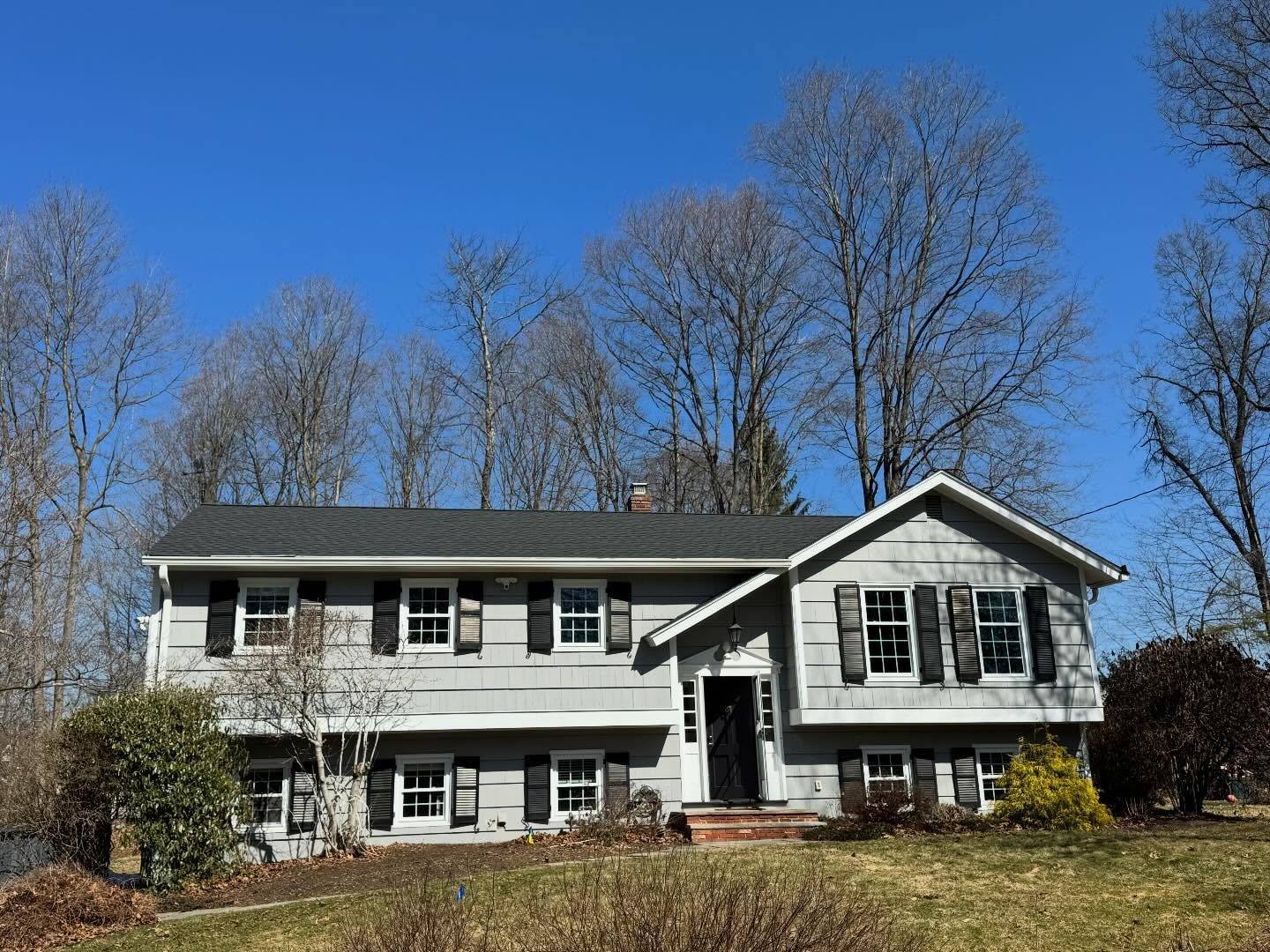
That decade is what you see from the curb today: brick and stucco Tudors, Dutch and center-hall colonials, steep gables and hips, close on narrow lots under street trees planted with the plat. The land the boom did not reach filled with capes, splits and ranches in the 1950s and 60s. The two fail differently. On the pre-war house it is flashing at brick chimneys and stucco sidewalls, wood sash painted shut, and 5-inch gutters choking under the canopy. On the post-war house it is aluminum over the original siding, a shallow rear pitch never right for shingle, and an attic never vented.
Water frames the township. The Hackensack River is the western border with River Edge and Hackensack; Overpeck Creek runs along the east, with the 800-acre county park beside it. Both are tidal, low ground, reclaimed from wetland where the parks are, so on the streets nearest them where a downspout ends matters as much as what is on the roof. If you have a leak now, start with roof repair; if the water is at the foundation, start with gutters.
The 1920s–30s boom left roofs of the same age with the same history: original covering long gone, then rounds of asphalt. We count layers at the eave, probe the deck, and price the tear-off before anyone signs.
The street trees that came with the plat are now a full canopy: leaves in the gutters twice a year, moss on north slopes, ice dams at the eave. We size gutters to the roof, fit guards where they earn their cost, and check the attic before we blame the gutter.
The Hackensack River and Overpeck Creek are both low, tidal ground. On the blocks nearest either one, downspouts run to daylight or a working drain and siding and trim are held clear of grade.
Teaneck Road carries Dutch sandstone houses from the 1700s, the pre-war grid, and a strip of flat-roofed storefronts. Each takes its own material: slate, cedar or standing seam on the oldest, membrane on the flat roofs, shingle on the rest.
The gables and hips of a Phelps Manor Tudor or colonial take a GAF or CertainTeed architectural shingle over ice-and-water membrane at eaves, valleys and walls. A Tudor that still carries slate gets repaired slate, not a tear-off. The flat roofs over Cedar Lane's storefronts get a fully adhered membrane. How long each lasts is its own question.
Stucco on a pre-war Tudor is masonry work: cracks cut out and patched, the roof joint reflashed, half-timber trim kept. On a 1950s cape or split with aluminum over the original wall, we open a test area, photograph what is behind it, and re-clad in fiber cement or quality vinyl over a proper weather barrier.
Wood sash on a 1920s colonial can often be restored and weatherstripped, with a storm panel outside, for less than replacement. A rotted frame gets a full-frame unit flashed into the wall. Costs are in our window pricing guide.
Seamless aluminum, 6-inch where the roof area calls for it, downspouts kept off the neighbor's foundation on a 60-foot lot. Copper on a Tudor where the owner wants it to outlast the roof. Decks round out the list.
Central Bergen is the county's lowland: the Hackensack and Saddle drainages, flat streets, houses built close together in the decades either side of the bridge. Less slate than the hill towns, more shingle, membrane and gutter work, and on every job the question of where the water goes.
ZIP code served: 07666.
Teaneck response, anywhere in 07666. Call (201) 446-5941 or request a free written estimate online.
Yes — all of 07666, from our Edgewater base. That covers the Phelps Manor blocks in the middle of the township, West Englewood on the east side, and the streets down to the Hackensack River. Most of the work is on 1920s–30s brick and stucco Tudors and colonials and on post-war capes and splits. That means architectural shingle and low-slope membrane roofing, slate and cedar repair where a Tudor still carries it, flashing and leak repair, siding, windows and doors, 6-inch gutters under the street trees, and decks.
Usually neither. An ice dam starts in the attic. Heat escaping through a pre-war ceiling melts snow on the upper roof; the water runs down to the cold eave, freezes over the gutter, and the next melt backs up under the shingle. Leaves from the 1920s street trees make the dam thicker but do not cause it. We check attic insulation and ventilation first, then whether the eave has ice-and-water membrane under it, then gutter size and guards. Fixing only the gutter moves the problem; fixing the attic ends it.
Because that joint depends on flashing, and on a house from the Phelps Estate boom it has usually been through several reroofs. Step flashing behind stucco should be let into the wall under a counterflashing; at a brick chimney the counterflashing has to be cut into a mortar joint. Each reroof tends to leave the old metal and caulk the gap, and stucco is porous enough that water finds it. We open the joint, fit new step and counterflashing, and repair the stucco or repoint the brick around it.
A free written estimate with photographs of what we found and the materials named by manufacturer, from a Bergen County exterior crew.