Roofing & exteriors in Paramus, NJ
Paramus is flat, wide and almost entirely post-war: ten square miles of 1950s capes, ranches and split-levels laid out on the old celery farms between the Saddle River and the Hackensack. Routes 4 and 17 and their malls run across the south. Roofs here are on their second or third shingle cycle, gutters are the 5-inch originals, and on ground this level every downspout needs somewhere to go.
Start with roof repair, roof replacement or gutter services.
Paramus is one of the largest boroughs in Bergen County, 10.51 square miles, and one of the flattest: about 49 feet above sea level, with almost no surface water inside its limits. The Saddle River and its county park run the western edge; the Hackensack River is the eastern boundary. Routes 4 and 17 cross in the south and the Garden State Parkway cuts through; the retail follows the highways, and the residential streets fill the blocks between.
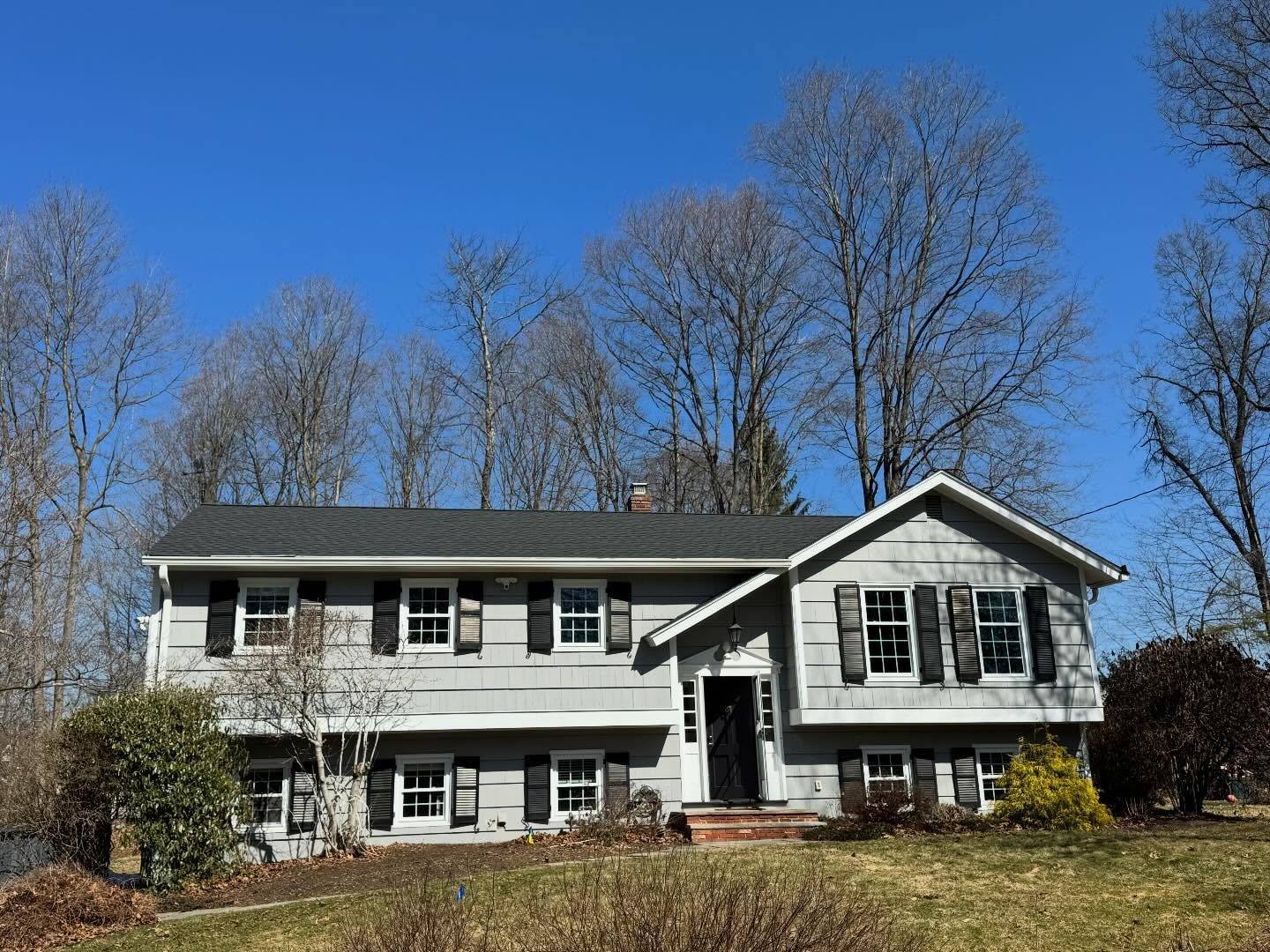
Into the 1940s this was Dutch-descended truck-farm country, famous for celery, with about 4,000 people and no town center. Then the George Washington Bridge opened, Routes 4 and 17 were widened, and the fields went to houses and stores. The population went from 6,000 to 23,000 between 1948 and 1958, and Garden State Plaza opened in 1957. The housing came in one burst, roughly 1948 to 1965: capes, ranches and split-levels on suburban lots, with 1960s and 70s colonials, the occasional pre-war farmhouse, and newer houses rebuilt on the same lots.
What fails first is what fails in any post-war borough, with one local twist. Roofs are on their second or third shingle cycle, often one layer over another. Aluminum or vinyl covers the original wood siding. The gutters are the 5-inch originals. The twist is the ground: with this little fall, water leaving a downspout goes nowhere on its own. Start with the roofing page, or call (201) 446-5941.
What we check first on a Paramus house
How many layers, and what is under them
A 1950s cape or ranch has had time for two shingle layers, the legal maximum, so the next roof is a full tear-off. We count layers at the rake edge before pricing and state a per-sheet price for soft decking, common on plank decks of that era.
Where each downspout ends
On flat ground with no natural drainage, a downspout that stops at a splash block is a foundation problem waiting for a wet spring. We trace every one to daylight, a drywell or a buried line, and nearest the Saddle River and the Hackensack we check the floodplain first.
Where the lower roof meets the upper wall
Split-levels put a low roof plane against a taller wall, and that joint is where most of them leak: missing step flashing, no kick-out, siding run down onto the shingles. We open that detail on every split before quoting. Common leak sources explains why.
Ventilation on low, wide attics
Ranches and capes have shallow attics that trap heat in summer and moisture in winter. We check whether the soffits are open, whether a ridge vent exists and whether insulation has blocked the eaves, then fix the venting with the roof.
The right materials for Paramus's housing stock
Architectural shingle, and membrane where the pitch is low
For capes, ranches and splits: full tear-off, ice-and-water membrane at eaves and valleys, synthetic underlayment and a ridge vent connected to open soffits. Where a ranch or a one-story wing is too shallow for shingles, we install a low-slope membrane instead. How long a roof lasts depends on the assembly, not the brand.
Six-inch seamless gutters that drain somewhere
We move from 5-inch to 6-inch seamless aluminum where the roof area calls for it, add downspouts where a long run has one, and route each to daylight or a drywell. On a lot this level the gutter is half the system; the underground half keeps the basement dry.
Siding over what is really there
Aluminum or vinyl on a Paramus house usually hides original wood and no housewrap. We open a section before quoting, then re-side in fiber cement or quality vinyl, flashed at every opening.
Windows and doors for 1950s frames
Original post-war windows are usually past saving; the frames behind them decide between insert and full-frame replacement. Facing Routes 4 and 17 or the Parkway, laminated glass takes a real bite out of traffic noise. What replacement costs here explains.
Post-war boroughs where the roof is already on its second life.
Central Bergen filled in fast after the war, along Routes 4 and 17 and on the level ground between the Saddle, Passaic and Hackensack rivers. An exterior contractor here is rarely the first on the house: the job is a tear-off over old decking, siding over original wood, and gutters treated as drainage.
Neighborhoods and streets we work in Paramus
ZIP code served: 07652.
- Arcola — post-war single-family streets, like most of the borough
- Bergen Place — capes, ranches and splits on their second or third roof
- Dunkerhook — toward the Saddle River County Park side; drainage checked first
- Fairway Oaks — post-war houses with the era's attic-venting and 5-inch-gutter questions
- Spring Valley — 1950s and 60s stock, with newer houses rebuilt on the original lots
- Between Routes 4 and 17 and the Parkway — residential streets behind the retail, where road noise decides the window choice; both river edges are checked against the floodplain
Paramus response, anywhere in 07652. Call (201) 446-5941 or request a free written estimate online.
Adjacent Bergen towns
Does Johannemann & Sons serve Paramus, NJ?
Yes — all of 07652, from Arcola, Bergen Place and Spring Valley to Fairway Oaks and Dunkerhook, and the residential blocks between Routes 4 and 17 and the Parkway. We handle roofing, siding, windows and doors, gutters and decks on the borough's post-war capes, ranches and split-levels, working across the county from our Edgewater base. Every estimate is written, with photographs and named materials, and it is free.
My Paramus split-level was re-roofed about twenty years ago and the shingles are already curling. Why?
Usually heat, not the shingle. A split-level has two or three roof planes at different heights, and the low attic over the bedroom wing and the flat ceiling over the garage often have no working soffit or ridge vent. Trapped summer heat cooks shingles from underneath and takes years off them. Before we quote a roof we check how air gets in at the eaves and out at the ridge. We correct the venting as part of the job rather than laying new shingles over the same problem.
Water pools along my foundation after every heavy rain. Is that a gutter problem?
In Paramus it often is. The borough sits at about 49 feet, is nearly flat and has almost no surface water, so runoff has almost no slope to carry it off. A downspout that ends at a splash block puts hundreds of gallons at the foundation in a single heavy rain. We size the gutters to the roof feeding them and run each downspout to daylight, a drywell or a buried line clear of the house. We also check that the grading falls away from the wall.
Do I need a permit to replace a roof or siding on a Paramus house?
For like-for-like roof or siding replacement on a one- or two-family house, New Jersey's construction code treats the work as ordinary maintenance and no permit is required. The code still governs how the underlayment and flashing go on, and we run ice-and-water membrane at the eaves and valleys even though New Jersey requires it only in Sussex County. A new or rebuilt deck, an enlarged window or door opening, or structural repair to the roof framing does need a permit from the borough, and we pull it and schedule the inspections as part of the job.
Roofing for the homes of Paramus, NJ.
A free written estimate with photographs and named materials, from a Bergen County exterior crew based in Edgewater.