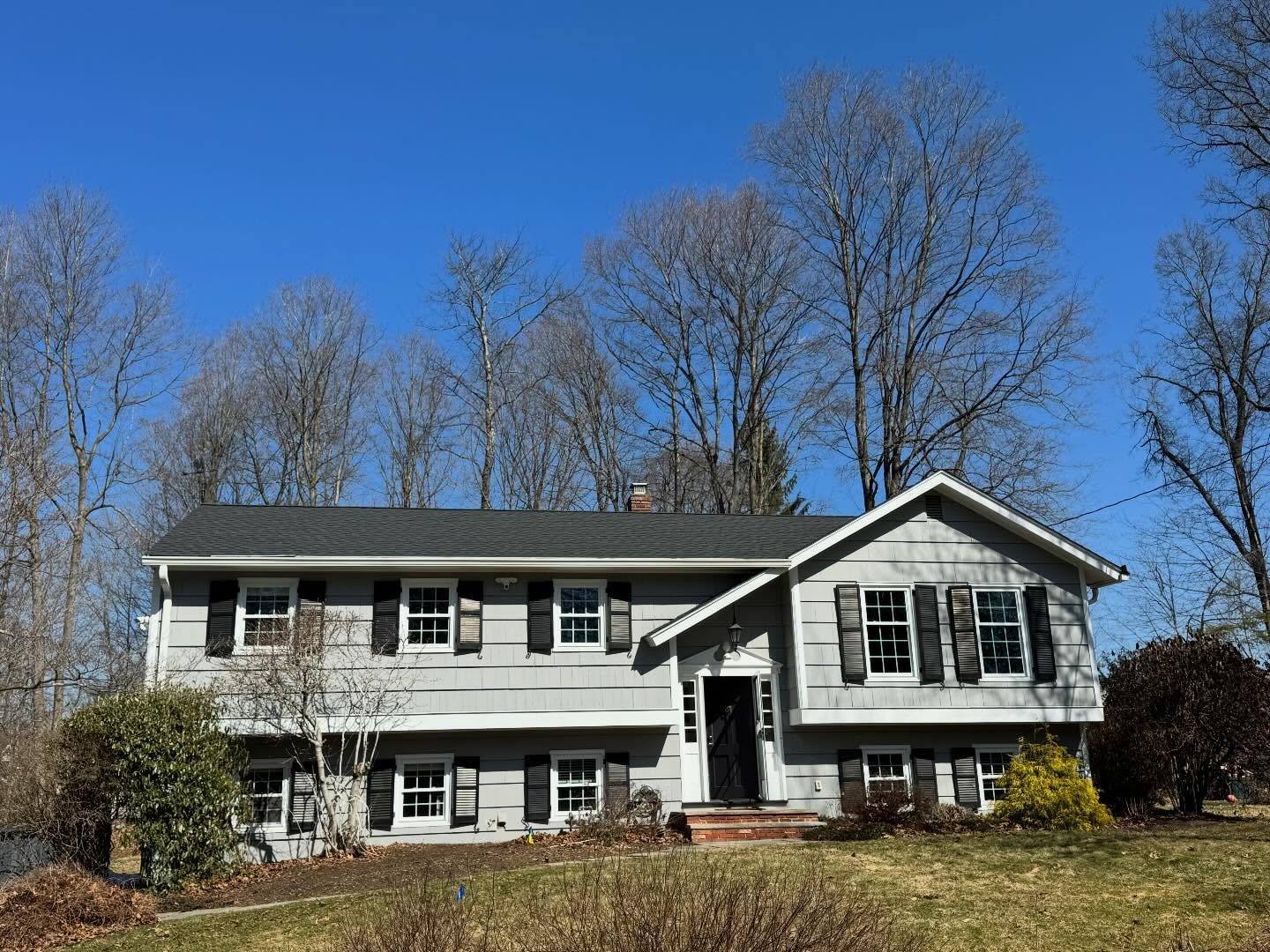
A railroad borough on the Hackensack River, with the Oradell Reservoir in its northeast corner and Kinderkamack Road as its one real spine. The houses are 1920s colonials and Cape Cods near the tracks, split-levels and ranches from the postwar years, and a few newer custom builds. Nearly all of them stand under mature street trees that set the terms for every roof and gutter.
In detail
Oradell grew up around its railroad. The line arrived in 1869–70, the Hackensack Water Works went in on Van Buskirk Island in 1881–82, and the first houses followed the tracks and Kinderkamack Road, still the borough's one significant road. The 1897 Atwood-Blauvelt Mansion, a shingle-style landmark, dates from that era. The borough incorporated in 1894 as Delford and took the Oradell name in 1920.
The dam on the Hackensack, built between 1921 and 1923 to form the reservoir, opened up the low, flood-prone east side, and the borough filled in from there. Colonials and Cape Cods came through the 1920s and 1930s, split-levels and ranches after the war, and newer custom builds where lots turned over later. The borough is almost entirely single-family and owner-occupied, and one street will often carry a steep-gabled colonial, a brick-front split and a ranch side by side.
That mix means two roof pitches and three claddings on one block. The colonials and capes have steep asphalt-shingle gables with ice-dam exposure at the eaves; the splits and ranches have lower slopes where shingles need heavier underlayment or a membrane. Siding runs from original clapboard and shingle to vinyl hung over it decades ago. We replace and repair roofs, re-side, replace and restore windows and doors, size gutters for the trees, and build decks across the borough. Start with roofing or call (201) 446-5941.
What is different here
Four things an Oradell roof has to deal with
A tree-lined borough, literally
Mature street trees load the gutters twice a year, shade north slopes into moss that lifts shingle granules, and drop limbs in a wind. We hang six-inch gutters, fit guards where the canopy is heavy, clear every valley before we leave, and note any limb over the roof on the estimate. More under gutters.
Low ground toward the river
The east side toward the Hackensack River is the low ground. The 1921–23 dam greatly reduced the flooding there, but streets near the river and the reservoir still sit in the floodplain. On those lots we run downspouts to daylight or a dry well, never to grade against the foundation.
Two roof pitches on one street
A 1920s colonial and a 1950s split-level share many Oradell blocks, and they are not the same roof. The steep gable wants ice-and-water membrane past the warm wall and a ridge vent; the low-slope split wants doubled underlayment or a membrane, and step flashing where a lower roof meets the taller wall. We specify each plane on its own.
Railroad-era houses near the tracks
The Victorian and Tudor-style houses from the first build-out along Kinderkamack Road carry wood siding, wood sash and often several roof layers. We restore sash where the wood is sound, replace it where it is not, and tear a roof off to the deck to replace sheathing a century of nail holes has ruined.
Architectural shingle over synthetic underlayment, ice-and-water membrane at eaves and valleys, a ridge vent matched to soffit intake, new step flashing at every wall and chimney. Cedar shake or slate on a railroad-era house that calls for it. Lifespans are in our New Jersey roof guide.
Six-inch seamless aluminum with oversized downspouts and discharge planned for the lot. Guards where the trees demand them, copper where the house does. What guards can and cannot do is in our gutter-guard article.
Fiber cement or insulated vinyl over a stripped, wrapped and flashed wall. Window replacement that fills the original opening, or sash restoration on the older houses. Composite or wood decks with the ledger bolted through the rim and flashed.
Central Bergen
Railroad suburbs on the Hackensack, filled in after the war.
The towns of central Bergen grew along the rail lines and the river, then filled in with split-levels and ranches through the 1950s and 1960s. Streets mix eras house by house, the trees planted then are mature now, and the low ground by the Hackensack drains slowly. The work is roof pitch, tree load and getting water away from the house.
One of our own jobs in the borough, and the one that capped off our 2025: an old timber deck and its stairs taken down, a new pressure-treated frame with new posts and stair stringers built in its place, and the deck finished in Trex composite with a rail of black balusters.
Kinderkamack Road and the streets off it — the borough's spine and oldest houses, railroad-era Victorians and Tudors beside later colonials.
Oradell Avenue, the main east–west street through the center — colonials and Cape Cods from the 1920s–30s build-out.
Maple Avenue and the blocks around Oradell station — the walkable center, closest to the Pascack Valley Line.
The northeast toward the Oradell Reservoir — the borough's watershed edge, where the reservoir runs on into Haworth and Emerson and the canopy is thickest.
The east side toward the Hackensack River and Van Buskirk Island — the low ground the dam opened up, where downspout discharge matters most.
The streets around Memorial Field, Schirra Park and the Doug Parcells Athletic Complex — mixed pre-war and postwar blocks.
Yes — all of Oradell, ZIP 07649, from the railroad-era houses along Kinderkamack Road to the wooded streets toward the reservoir and the low ground by the Hackensack River. We replace and repair roofs, re-side, replace and restore windows and doors, hang gutters sized for the tree canopy, and build decks on the borough's colonials, Cape Cods, split-levels and ranches. Every estimate is written, with photographs and named materials.
Why do gutters in Oradell fill so fast, and are guards worth it?
Oradell is a tree-lined borough, and the street trees are mature. They drop leaves, seed pods and pollen strings into gutters from spring through November. A five-inch gutter on a steep colonial roof overflows at the first heavy rain once it is half full, which is how water ends up behind the fascia and in the basement. We hang six-inch gutters with larger downspouts, and under heavy canopy we fit a solid-surface or fine-mesh guard that sheds leaves. Guards cut cleanings; they do not end them.
My Oradell split-level has a low-slope section. Can it take regular shingles?
It depends on the pitch. Asphalt shingle is rated down to a 2:12 slope, but between 2:12 and 4:12 the manufacturer requires doubled underlayment or a full ice-and-water membrane beneath the shingles, and we install it that way. Below 2:12, shingles hold water at every course and fail early, so those sections get a fully adhered membrane instead, tied into the shingle roof above with a proper transition flashing. We measure each plane on the estimate visit and put the pitch in writing.
Free assessment
Roofing for the homes of Oradell, NJ.
A free written estimate with photographs and named materials, from a Bergen County exterior crew working out of Edgewater.