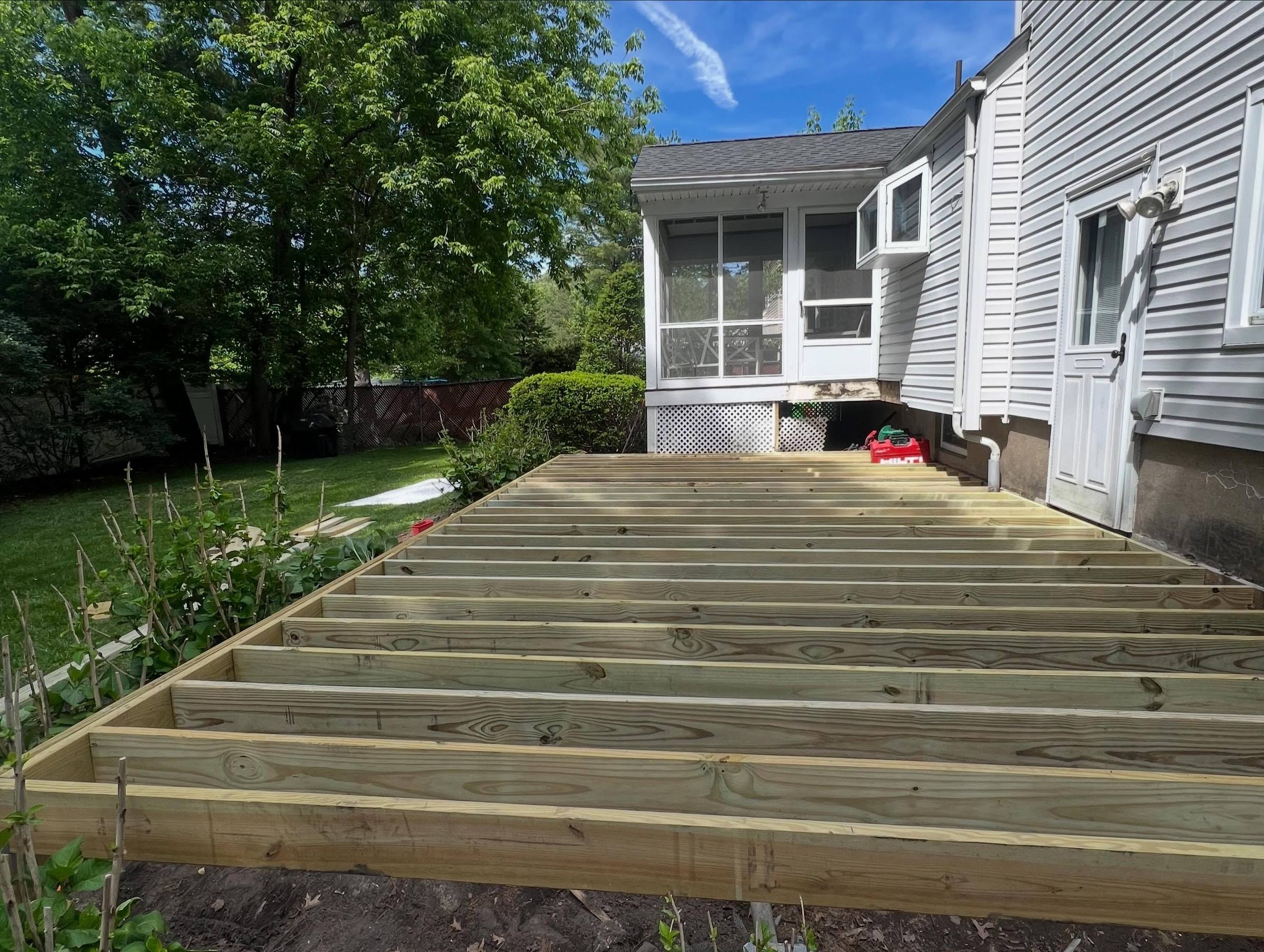
Do You Need a Permit to Build or Repair a Deck in New Jersey?
It depends on whether you are repairing a deck or building one. Boards, railings, stairs, even joists and posts can be replaced in kind with no permit. A new deck, or a complete rebuild, needs a permit, and usually zoning approval before that.
Every town in New Jersey enforces the same Uniform Construction Code, and the code puts each piece of work on a house into one of three groups. Ordinary maintenance can be done without a permit, a notice or an inspection. Minor work is permitted work that may begin as soon as the town is notified. The rest waits for a permit to be issued. Decks are unusual in that they skip the middle group: repairs are ordinary maintenance, and a new deck or a complete replacement needs a full permit.
The repair rule changed in February 2021, and a lot of what is written about deck permits in New Jersey, including some state guidance and, until today, this site, predates it. What follows is the rule as it reads now for a deck on a one- or two-family house, with the sections it comes from. This is general information about the code in October 2026, not legal advice; how it applies to a particular deck is your construction official’s call.
Repairs: no permit, structure included
Section 2.7 of the code defines ordinary maintenance. It starts by saying what ordinary maintenance can never be, and two items on that list are removing or cutting a structural beam or bearing support, and any work affecting structural or fire safety. Read on their own, those would put a rotted joist or post outside it.
The deck rule overrides them. Section 2.7(c)1xiii lists as ordinary maintenance, “notwithstanding” those two items, the repair or replacement of any part of a deck, porch or stoop that does not provide structural support for any roof or portion of a building, and adds that the materials used have to be identical or closely similar to the existing ones and go in the same location. “Notwithstanding” means those two exclusions do not stop a deck repair that meets the rule’s conditions. The word arrived with the February 2021 amendment, together with the requirement for matching materials in the same location. So three conditions decide it:
- The deck holds up nothing else. If a roof, a porch ceiling or part of the house bears on it, repairs to it are not ordinary maintenance.
- The materials match. Identical, or closely similar, to what comes out.
- The location stays the same. A board, joist, post or stair goes back where the old one was.
Within those limits, replacing boards, railings, stair treads and stringers, a run of joists or a rotted post is ordinary maintenance. The state is explicit that this is not a waiver: ordinary maintenance still has to meet the code, it just is not inspected. A post set on a bad footing is still a bad post.
What “closely similar” leaves open
The code does not define closely similar, and that is where the real questions come up. Pressure-treated boards replaced with new pressure-treated boards are plainly fine. Wood boards replaced with composite, a wood railing replaced with an aluminum or vinyl system, or a joist replaced with a deeper one are less clear, and the person who decides is your town’s construction official, not the contractor and not the homeowner. A short call before the material is ordered settles it.
It is worth checking for a practical reason too. A composite or PVC board has its own maximum joist spacing set by its maker, and the framing under an old wood deck was laid out for the wood. Whether or not a permit is needed, the new boards have to suit the joists they sit on.
New decks and complete rebuilds: a full permit
Building a deck is construction, and under section 2.14 construction needs a permit unless the code carves it out. Minor work does not help here: section 2.17A puts the construction or total replacement of a porch or stoop into minor work, but not a deck. The state’s Division of Codes and Standards put it plainly when that list was settled in 2018: the construction or complete replacement of a deck requires a full permit. It had proposed treating deck replacement as minor work and decided against it, because local setback rules could leave a homeowner building a deck the town would not have allowed.
The same goes for a deck that grows or moves. A larger deck, or one rebuilt in a new spot, is not a replacement in the same location, and a deck built to carry a roof is outside the repair rule altogether. All of these need the permit issued before work starts.
| The job | Where the code puts it |
|---|---|
| Deck boards replaced with the same or a closely similar board | Ordinary maintenance: no permit, notice or inspection (2.7(c)1xiii) |
| Railings, stair treads or stringers replaced in kind | Ordinary maintenance (2.7(c)1xiii) |
| Rotted joists, beams or posts replaced in kind, same location | Ordinary maintenance, if the deck holds up no roof or part of the house (2.7(c)1xiii) |
| Boards or railings changed to a different material | Ask the construction official whether it is “closely similar” |
| A new deck | Full permit before work, usually after zoning approval (2.14, 2.16) |
| The whole deck torn off and rebuilt | Full permit before work (DCA, Spring 2018) |
| A deck enlarged or moved | Full permit before work |
| A deck that holds up a roof | Outside the repair rule; ask the construction official |
| Up to five new outlets on existing capacity | Minor work: start on notice, permit within five business days (2.17A(c)4) |
Zoning comes first
A new deck has to fit the town’s zoning before the building department will issue anything. The permit application includes a statement that all required state, county and local prior approvals have been given, and under section 2.16 the permit is not issued until their conditions are met. Zoning is the usual one for a deck: how close it may come to the property lines, and how much of the lot it adds to the covered area. Those numbers are set by each town’s ordinance, so they differ between, say, Ridgewood and Wyckoff, and between zones within one town.
Allendale’s own permit page is a good example of how this reads locally: it lists installing a brand-new deck among the jobs that need a permit, lists replacing any part of an existing deck among the ones that do not, and notes that major work “in most cases also requires a zoning approval”. Have a copy of your property survey to hand; a zoning review is usually done against it.
What the inspector looks at on a new deck
Once the permit is issued, the inspections follow the order the deck is built in. The footing holes are inspected before the concrete goes in. The framing, including the connection to the house, is normally inspected before the boards cover it. Then there is a final inspection, after which the construction official issues a certificate of approval for the work. A deck does not need the foundation location survey a new house or addition does; the code exempts decks, pools and sheds from it.
The connection to the house is the detail that matters most. A deck that is attached to the house hangs one side on a ledger board, and a ledger that is nailed rather than bolted, or that lets water in behind it, is the most common reason decks fail. It is part of the framing the inspector sees before the boards go down.
Why it matters when you sell
A deck is one of the easiest things for a buyer’s inspector or a town to spot that does not match the permit record, because it is outside and in plain view. Work that needed a permit and did not have one tends to come up at the sale, when there is the least time to deal with it and the framing is long covered. A permit that was filed and closed with a certificate of approval is the simpler thing to hand a buyer. Repairs that were genuinely ordinary maintenance need no paperwork at all, which is the other reason to know which group a job falls in.
How we handle permits on a deck
On every deck we build or repair, we sort the job into these groups at the estimate, so you know before anything is ordered whether there will be a permit. For a repair in kind, there is none, and we tell you so. Where the materials would change, we check with your construction official before we order. For a new deck or a complete rebuild, we draw it up, take it through the town’s zoning review and the construction permit, book the inspections and are there for them. A contractor’s state registration number goes on every permit application; ours is 13VH11045200.
Two of our recent decks, a Trex deck in Oradell and a Trex deck over the Hudson in Edgewater, show what the work looks like from demolition to the finished boards. For other work on the house, our guides to roof permits and to addition permits and zoning explain the rules for those.
Sources
- N.J.A.C. 5:23-2.7 (ordinary maintenance), 2.14 (when a permit is required), 2.15 (permit applications), 2.16 (permit procedure), 2.17A (minor work), 2.18 (inspections) and 2.23 (certificates), in the Division of Codes and Standards’ own copy of the regulation, current through August 17, 2026, including the History note for the February 16, 2021 amendment (PDF).
- Department of Community Affairs, proposal of the 2021 amendments to ordinary maintenance and minor work (PDF).
- Construction Code Communicator, Spring 2018, on the construction or complete replacement of a deck (PDF), and the Division’s ordinary maintenance and minor work reference of March 5, 2018 (PDF).
- Borough of Allendale, Do I Need a Permit?
Do I need a permit to replace deck boards in New Jersey?
No. Replacing the boards on an existing deck with the same or a closely similar material, in the same place, is ordinary maintenance under the state code: no permit, no notice to the town and no inspection. The work still has to meet the code; it simply is not inspected.
Do I need a permit to replace rotted joists or posts on my deck?
Not since February 2021, as long as three things hold: the deck does not hold up a roof or any part of the house, the new members are identical or closely similar to the old ones, and they go in the same location. The code now says this applies even though structural work is otherwise excluded from ordinary maintenance. Older guides that say posts and joists need a permit were written before that change.
Do I need a permit to rebuild my deck on the same footprint?
Yes. The state's Division of Codes and Standards says the construction or complete replacement of a deck requires a full permit, issued before the work starts. It considered treating deck replacement as minor work and decided against it, because local setback rules could leave a homeowner building a deck the town would not allow.
Do I need zoning approval for a deck in Bergen County?
For a new deck, usually. Setbacks and lot coverage are set by each town’s zoning ordinance, and the construction permit is not issued until required local approvals are in place. Allendale, for example, says major work such as a new deck needs a construction permit and in most cases a zoning approval. Your town’s zoning officer can tell you what applies to your lot.
Can I switch from wood deck boards to composite without a permit?
Possibly, but check first. Ordinary maintenance requires materials that are identical or closely similar to the ones they replace, and the code does not define closely similar. Your construction official decides whether a different board counts. If the whole deck is being replaced anyway, it needs a permit whatever the boards are made of.
Do I need a permit to add lights or an outlet to my deck?
Yes, some form of it. New electrical wiring is never ordinary maintenance. In a one- or two-family house, adding five or fewer outlets where the existing circuits or panel space can carry them is minor work: the town is notified before work starts and the permit application follows within five business days. The work is done by a licensed electrician unless you are a homeowner working on your own single-family house.