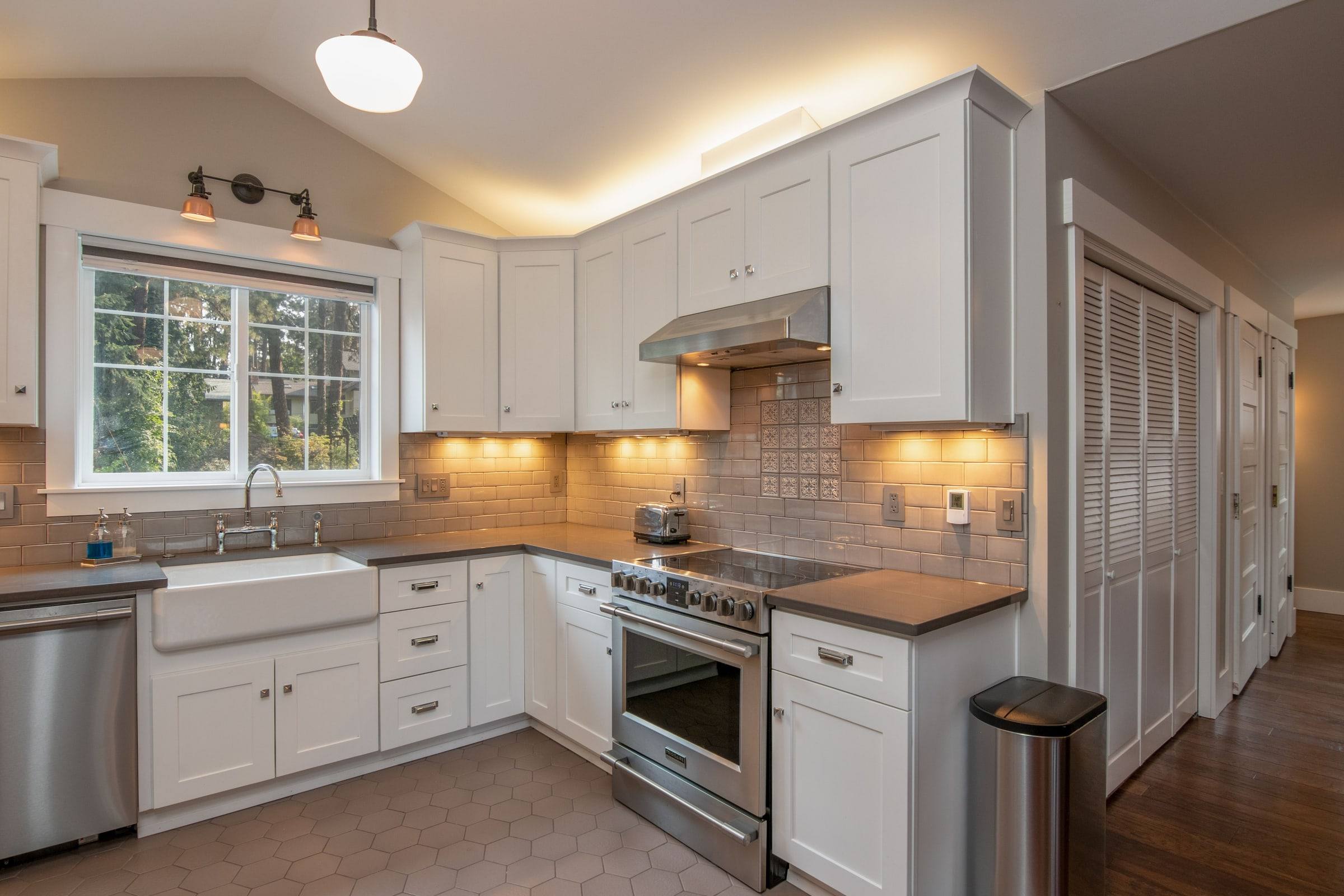
Do You Need a Permit to Remodel a Kitchen in New Jersey?
It depends on what the remodel touches. New cabinets, floors and paint need no permit at all. Moving a pipe, adding outlets or taking out a wall does, and the code says which kind.
New Jersey has one construction code for every town, the Uniform Construction Code, and it sorts kitchen work into three groups. Ordinary maintenance needs no permit, no notice to the town and no inspection. Minor work needs a permit, but it can start as soon as the town has been told. Everything else needs a permit issued before the work begins. Most kitchen remodels contain a little of all three, and knowing which part is which tells you what the paperwork will look like before anyone pulls a cabinet off the wall.
What follows is how those rules read for a kitchen in a one- or two-family house, with the sections they come from. It is general information about the code as it stands in October 2026, not legal advice: your town’s construction official decides how it applies to your house.
The rule, and the two exceptions
The starting point is simple. Under N.J.A.C. 5:23-2.14 it is unlawful to construct, alter, renovate or repair a building, or to install equipment the code regulates, without first applying for and getting a permit. Two exceptions carve out most of what happens in a kitchen. Ordinary maintenance, defined in section 2.7, needs neither a permit nor notice. Minor work, defined in section 2.17A, still needs a permit, but the work may proceed once the town has been notified, before the permit is issued.
The code also says what ordinary maintenance can never be. Cutting away any part of a load-bearing wall, removing a structural beam or bearing support, and adding to, altering, replacing or relocating water, drain, waste, vent or gas piping or electrical wiring are all excluded from it, along with anything affecting structural or fire safety. The code then names specific exceptions inside those categories, which is where the kitchen detail lives.
What needs no permit at all
Section 2.7(c) lists work every town must treat as ordinary maintenance. The list is long, and it says itself that it is not all-inclusive. The parts that matter in a kitchen:
- Cabinets and other non-structural built-ins, repaired, replaced or installed.
- Flooring, any material replaced with a new one.
- Painting and wallpaper, anywhere.
- Drywall and plaster on less than 25 percent of the wall area in a one- or two-family house. Paneling is not included.
- Trim and moldings, repaired, replaced or installed.
- The window over the sink, or a door, replaced in the same opening without changing its size or framing.
- Faucets, traps and fixtures, where a fixture is replaced with a similar one and the piping arrangement does not change.
- The dishwasher, replaced.
- Outlets, switches and light fixtures, replaced with like or similar items. Where an outlet has to be ground-fault protected or tamper-resistant, the replacement has to be too.
- The range or oven, replaced, as long as the fuel, the gas pipe size, the location and the electrical supply stay the same.
- The range hood, replaced, if the new one moves no more air than the old one or no more than 400 cubic feet per minute, and it either recirculates or vents on its own to the outside.
Countertops are not named on the list. If new countertops are the whole job and the sink goes back in the same place with no change to the piping, it is worth a short call to your construction official to confirm how your town treats it; the plumbing part, at least, is ordinary maintenance.
What counts as minor work
Minor work is the middle ground, and a lot of kitchen work falls into it. The owner, or the contractor acting for the owner, notifies the construction office before work begins, in person or electronically, with a brief description and the address. The permit application follows within five business days. Inspections are still required: the town has to inspect within three business days of a request, or at another time within 30 days that both sides agree, and then issues a certificate of approval for what it saw.
In a one- or two-family house, section 2.17A names these as minor work:
- Renovation or alteration of an existing house, as long as no primary structural member is altered in any way and the work is not a reconstruction.
- New outlets, five or fewer, where the existing circuits, or spare space in the panel and the service, can carry the load.
- New electrical work for a range or oven, such as the circuit a new range needs.
- Rewiring with new wiring of the same capacity.
- Replacement plumbing pipe of like capacity, such as old galvanized supply lines replaced with new.
- A new fixture in existing space, such as a prep sink in an island, where it can be added without increasing the size of the water distribution system, the water service or the house drain.
Drywall on more than a quarter of the walls takes a kitchen out of ordinary maintenance, but with no structural change it falls under the first item above, renovation of an existing house, and so it is minor work.
What needs a full permit first
Anything that is neither ordinary maintenance nor minor work needs a construction permit issued before the work starts. In a kitchen, the clearest case is structure. Taking out or cutting a load-bearing wall, or removing a beam or post, alters a primary structural member, which rules out minor work, and the permit will normally need an engineer’s drawings for the beam that carries the load instead. A larger electrical service is another: it is not like-capacity rewiring, and it is not on the minor-work list.
Two common changes sit in between. Switching a gas range to an induction one changes the fuel, so it is not ordinary maintenance: the new range circuit is minor work, and the construction official will tell you what the gas line needs. And a hood that moves more air than both the old one and 400 cubic feet per minute falls outside ordinary maintenance; the list covers repairing and replacing duct work, not a new duct cut through an outside wall or the roof.
| The job | Where the code puts it |
|---|---|
| New cabinets, flooring, paint, trim | Ordinary maintenance: no permit, notice or inspection (2.7(c)1) |
| Drywall or plaster on under 25% of the walls | Ordinary maintenance (2.7(c)1ii) |
| Faucet, sink, dishwasher swapped in place | Ordinary maintenance, if the piping arrangement does not change (2.7(c)2) |
| Outlets, switches, light fixtures swapped for like items | Ordinary maintenance (2.7(c)3i) |
| Range, oven or hood replaced, same fuel and supply | Ordinary maintenance, within the hood’s airflow limit (2.7(c)3v, 5vi, 5viii) |
| Up to five new outlets on existing capacity | Minor work: start on notice, permit within five business days (2.17A(c)4) |
| New circuit for a range or oven | Minor work (2.17A(c)4) |
| Prep sink in an island, no larger supply or drain | Minor work (2.17A(c)2) |
| Partition removed or moved, nothing structural touched | Minor work (2.17A(c)1ii); wiring or pipes inside it bring in those subcodes |
| Load-bearing wall or beam removed | Full permit before work, usually with engineered drawings (2.7(b), 2.17A(c)1ii) |
| Larger electrical service | Full permit before work (2.7(b)6iii, 2.17A(c)4) |
Who can do the plumbing and electrical
The code is plain about this. Plumbing, electrical and heating work has to be done by contractors licensed for it, and the licensed contractor’s seal and signature go on the matching part of the permit application. The one exception is a single-family homeowner working on his or her own home, who may do the work but still needs the permit and the inspections.
The general contractor matters too. When a contractor performs home improvement work, it has to be registered with the state under N.J.S.A. 56:8-136 and the following sections, and its registration number has to appear on the permit application. Ours is 13VH11045200. Asking for that number before you sign is the quickest check there is.
Why it matters when you sell
Inspections exist because most of a kitchen’s plumbing and wiring is about to disappear behind drywall and cabinets. The rough work gets looked at while it can still be seen, and the final inspection closes the permit. Work that should have been inspected and was not tends to come up later, when it is harder to show what is inside a finished wall, often when the house is being sold. A permit that was filed and closed is the simpler record to hand a buyer.
How we handle permits on a kitchen
On every kitchen we build, we sort the job into these three groups at the estimate, so you know before work starts which parts need a permit and roughly how the inspections will fall in the schedule. We file the notices and applications, book the inspections and are there for them, and the plumbing and electrical go to licensed contractors we schedule and run, whose seals go on their parts of the application. Where a wall comes out, we bring in the engineer before the permit is filed, not after the wall is open.
If the kitchen you want does not fit the room you have, our guide to addition permits and zoning covers building out, and our page on additions covers how we build them. For the outside of the house, our guide to roof permits in New Jersey explains why a re-roof on a detached house needs none, and our guide to deck permits covers repairs and new decks.
Sources
- N.J.A.C. 5:23-2.7 (ordinary maintenance), 2.14 (when a permit is required), 2.15 (permit applications, licensed trades and contractor registration) and 2.17A (minor work), in the Division of Codes and Standards’ own copy of the regulation, current through August 17, 2026 (PDF).
- The Contractors’ Registration Act, N.J.S.A. 56:8-136 et seq., as referenced in N.J.A.C. 5:23-2.15.
Do I need a permit to replace kitchen cabinets in New Jersey?
No. Cabinets are non-structural built-ins, and the state code lists their repair, replacement or installation as ordinary maintenance: no permit, no notice to the town and no inspection. If the same job moves a sink, adds outlets or takes out a wall, those parts of it need a permit.
Do I need a permit to replace a kitchen sink or faucet?
Not for a like-for-like swap. Replacing a faucet, a trap, a dishwasher or a sink with a similar fixture is ordinary plumbing maintenance as long as the piping arrangement does not change. Moving the sink, or adding a second one, is not, and needs a permit.
Do I need a permit to add outlets in my kitchen?
Usually a minor work permit. In a one- or two-family house, adding five or fewer outlets is minor work when the existing circuits, or spare space in the panel and the service, can carry them. Work can start once the town has been notified, the permit application follows within five business days, and the work is inspected. Swapping an existing outlet or switch for a similar one needs no permit at all.
Do I need a permit to take out a wall between the kitchen and dining room?
If the wall is load-bearing, yes, and the permit has to be issued before the work starts, normally with an engineer’s drawings for the beam that replaces it. Taking out a partition that carries nothing is generally minor work, provided no structural member is touched, though the wiring, vent or pipe that often runs inside it brings in the electrical or plumbing subcode too.
Can I replace my range hood without a permit?
Yes, if the new hood moves no more air than the old one or no more than 400 cubic feet per minute, and it either recirculates or vents on its own to the outside. A hood that moves more air than both the old one and 400 cubic feet per minute is not ordinary maintenance, and a new duct cut through the wall or roof is not on the ordinary maintenance list either.
Can I do my own kitchen plumbing or electrical work in New Jersey?
Only in a single-family house that you own and live in. Otherwise plumbing, electrical and heating work has to be done by a licensed contractor, whose seal goes on the permit application. Either way, the permit and the inspections still apply.