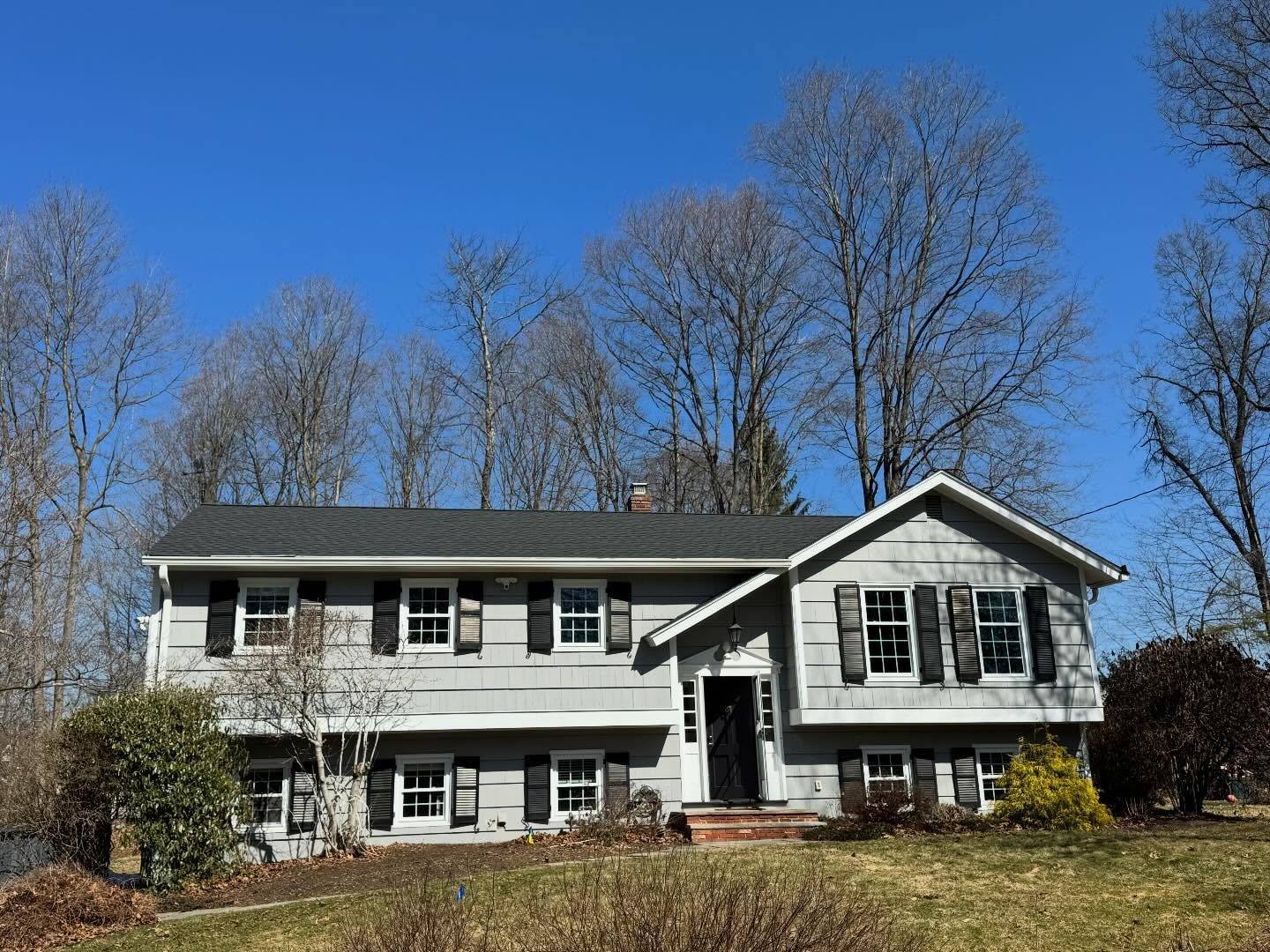
Rochelle Park is a one-square-mile township low in the Saddle River valley, about 5,800 people between the Parkway corner and Route 17, and by the township's own figure a third of it is floodplain. 1920s capes and bungalows stand beside post-war splits and ranches on compact, flat lots, so the roof is only half the question; where its water lands is the other half.
In detail
Rochelle Park is a township of just over one square mile in central Bergen County, low in the Saddle River valley, with the river along its western side and its tributary Sprout Brook inside the limits. The Garden State Parkway clips the northwest corner and Route 17 runs the eastern edge, with commercial strips along Route 17 and Passaic Street. The township says it floods from both, and that about 32 percent of its land lies in their floodplain.
The land was farmed through the 1800s; the Cornelius Demarest House of 1824 to 1826 and the Italianate Captain William Tyson House from the mid-1860s survive from that time. Midland Township from 1871, it took its present name, after the port of La Rochelle, in a 1929 referendum held to end confusion with Midland Park. Midland School had opened in 1926, so the grid was filling in through the 1920s, and the highways that later fixed the edges left the flat land between them to a dense post-war suburb: a 1920s cape or bungalow beside a split or ranch, asphalt-shingle gables and hips over most, vinyl or aluminum over some original wood.
The township names the Saddle River and Sprout Brook as its flood sources and keeps elevation certificates at the Building Department. Ground beside a foundation is often wet before the rain starts; a downspout ending there makes it worse. Every discharge we install is carried away from the wall.
Flat valley land, small lots
On ground with no fall, a downspout is a decision, not a fitting. One that ends in a shared side yard wets two foundations; one at a walkway makes ice in January. We plan each outlet toward the front or rear of the lot.
Two building eras on one block
The 1920s frame house and the 1960s split beside it fail in different places: the older one at chimney flashing reset around one shingle layer too many, the newer one with ice dams because its attic breathes through two small gable vents. We look in the attic and count layers before we price either.
Highways on two edges
The Parkway crosses the northwest corner and Route 17 runs the eastern border. The nearest houses carry road grit on their walls and hear traffic through any sash that has lost its seal; there we favor a smooth cladding and windows with a tested air-leakage number.
A shingle roof on a low valley lot rarely fails from wind; it fails from below, when warm attic air melts snow on the upper slope and the meltwater refreezes at the cold eave. So we balance soffit intake against ridge exhaust, carry ice-and-water membrane two feet past the inside of the exterior wall, and choose an architectural shingle with a printed wind rating. Leaks are traced to their source first; see our leak guide.
Seamless aluminum, hung with fall toward the outlets, is the easy part. The harder question on a floodplain lot is the last ten feet: a downspout should reach a splash block on falling ground, a buried line to the street or a rear drywell, never a bare patch beside the foundation. Each discharge point is marked on the estimate. Where a lot backs onto the county park, gutter guards keep the outlets clear.
On a frame house re-clad once or twice, the water gets in where wall meets roof and where wall meets window. We strip to the sheathing, fit a sill pan under every opening, tape the housewrap to the window flanges, add kick-out flashing where a roof edge dies into a wall, then hang fiber cement or heavy-gauge vinyl held above grade. Soft old frames come out full-frame the same visit; see our window pricing guide.
A deck on a floodplain lot stands on its footings. We dig below frost depth to firm soil, set the posts on standoff bases so end grain never sits in water, and keep the joists high enough to dry after a wet week. Composite or pressure-treated decking, a ledger through-bolted and flashed, railings to code, laid out to the setback line and clear of the downspouts.
Central Bergen
River-valley towns where the water has nowhere to go.
The central county's river-valley towns share a problem the hills to the north do not have: nothing falls away. Low ground, small lots and a century of building leave a roof's water few good places to land, so the drainage plan matters as much as the shingle. We price and build the two as one job.
Yes, all of 07662: the lowest streets along the Saddle River and the county park, the blocks off Passaic Street around Midland School and Sacred Heart, and the houses up against Route 17 and the Parkway corner. We come across the county from our Edgewater base. In Rochelle Park the work is mostly shingle roof replacement and leak repair, siding and windows on frame houses, downspouts routed for a floodplain lot, and decks.
My house is in the floodplain. What does that change about the roof and gutters?
It changes what happens to the water after it leaves the roof. The township puts about 32 percent of its land in the Saddle River and Sprout Brook floodplain, so the ground beside a foundation is often wet before the rain starts, and a downspout dumping there only adds to it. We plan each discharge to falling ground, a buried line or a drywell, keep the bottom of the siding and trim above grade, and frame anything low, a deck or a porch skirt, so it can dry out after a wet week.
Does a roof replacement in Rochelle Park need a permit, and do we pull it?
Not for a straightforward re-roof of a detached one- or two-family house: New Jersey's Uniform Construction Code treats replacing the roof covering as ordinary maintenance, with no permit. Replacing sheathing does need one, and so does a townhouse roof; when a job needs a permit we file it under our own registration, meet the inspector and close it, so nothing lands on your desk. Two layers of asphalt shingle is the limit, and plenty of the 1920s houses here already have both, which is why we count layers at the eave and write the tear-off into the estimate instead of discovering it on the day.
Free assessment
Roofs and exteriors for the homes of Rochelle Park, NJ.
We photograph the roof, walls and gutter runs and write a free estimate naming each material at a fixed scope, from an exterior crew that works Bergen County out of Edgewater.